


 By
Apple’s Smart Home Revolution: Siri AI Could Power a New Generation of Connected Devices
Apple is heading into October with another major chapter in its electronics strategy. After a busy September that introduced new iPhone hardware and software updates, attention is now turning toward Apple’s reported plans for the smart home.
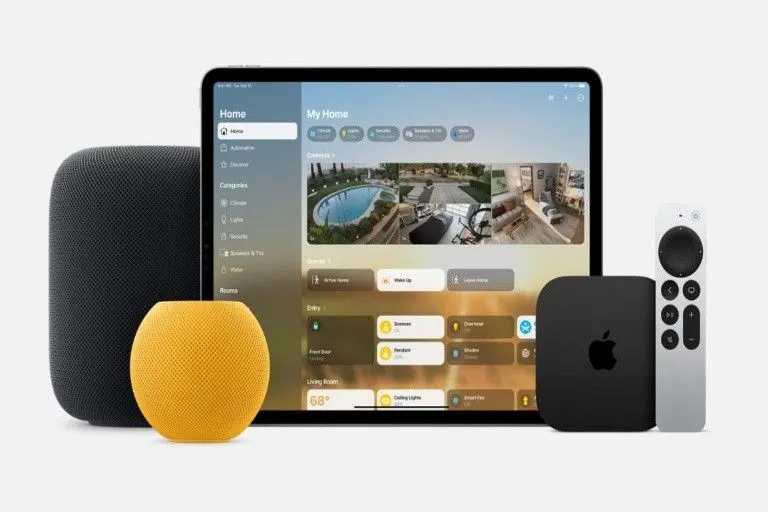
Recent reports indicate that Apple could introduce a new smart-home hub, an updated HomePod mini and a new Apple TV 4K around October 13. The company has not officially confirmed this October 13 hardware launch, so the reported specifications and launch plans should be treated as unconfirmed until Apple makes an announcement.
A New Smart-Home Hub Could Be the Centerpiece
The most interesting product in the reported lineup is a dedicated smart-home hub. According to Reuters, the device is expected to feature a roughly 6-inch square display and could be used on a countertop or mounted on a wall.
The idea is significant because Apple has traditionally relied on the iPhone, iPad, Apple Watch, HomePod and Apple TV to control smart-home experiences. A dedicated screen could provide a permanent interface for controlling connected devices, checking information and interacting with Siri.
The reported hub could also use AI to recognize household members and provide personalized content. If these capabilities arrive as reported, Apple would be moving toward a more personalized smart-home experience rather than simply offering another smart speaker.
Siri AI Is the Key Technology
The potential smart-home push comes at an important moment for Apple’s artificial-intelligence strategy.
Apple recently began rolling out Siri AI as part of its latest software updates. Apple describes the new Siri as more conversational and capable, with features including personal-context understanding, onscreen awareness and the ability to perform actions across apps.
Siri AI is being integrated across Apple’s ecosystem, including iPhone, iPad, Mac, Apple Watch and Apple Vision Pro. Apple says users can ask Siri about information on their screen, use it to write and edit text, and interact with information across apps.
For the smart home, these capabilities could make voice interaction much more useful. Instead of treating Siri as a simple command-based assistant, Apple is positioning it as a more intelligent interface that understands context.
HomePod Mini and Apple TV Could Get Faster
Reports also point toward updated versions of the HomePod mini and Apple TV. The products are reportedly expected to retain familiar designs while receiving faster processors that can support Apple’s newer Siri AI capabilities.
This approach would fit Apple’s broader strategy of keeping its ecosystem visually consistent while upgrading the technology inside its products.
An updated Apple TV could become more than an entertainment device if it also serves as part of a wider smart-home system. Similarly, a faster HomePod mini could become another access point for Siri AI throughout the home.
Apple’s AI Strategy Is Expanding Across Hardware
The reported smart-home products are arriving as Apple continues to push AI deeper into its electronics ecosystem.
Apple’s latest Mac mini and Mac Studio, for example, are powered by new Apple silicon and macOS 27. Apple says the new Mac mini can deliver up to four times faster AI performance than its predecessor in certain workloads, while the Mac Studio supports up to 512GB of unified memory in its highest configuration.
This illustrates how Apple is increasingly designing hardware around AI workloads rather than treating artificial intelligence as a purely cloud-based technology.
What This Could Mean for Consumers
If Apple’s reported smart-home products arrive, the company could offer consumers a more unified way to interact with technology at home.
A dedicated hub could provide a central control point, while HomePod mini and Apple TV could extend the experience into different rooms and entertainment setups. Siri AI could then act as the software layer connecting these devices.
The biggest question will be how much of this experience works seamlessly in everyday situations. Apple’s advantage is its tightly integrated hardware and software ecosystem, but smart-home technology remains a competitive market involving many companies and device standards.
October Could Be Another Important Month for Apple
Apple’s reported October plans show how the company’s focus is expanding beyond smartphones and computers. The iPhone remains central to the ecosystem, but AI, home automation and connected devices could become increasingly important parts of Apple’s electronics strategy.
With Siri AI already rolling out and several smart-home products reportedly approaching launch, October could provide a clearer picture of Apple’s next stage in consumer electronics.
For technology enthusiasts, the biggest story may not be one individual device. It could be how Apple connects AI, hardware and the home into one increasingly intelligent ecosystem.