


 By
By Application Security in 2026: Building Secure Software to Defend Against Modern Cyber Threats
Applications power nearly every aspect of modern business, from online banking and e-commerce platforms to healthcare systems, educational portals, and enterprise software. As organizations accelerate digital transformation and cloud adoption, applications have become one of the primary targets for cybercriminals. In 2026, application security is no longer an optional consideration—it is a critical component of software development that protects sensitive data, business operations, and customer trust.
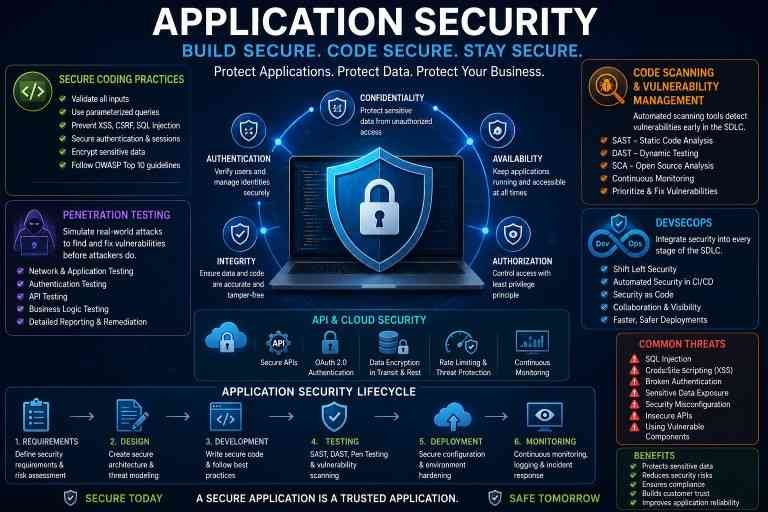
Application Security (AppSec) refers to the processes, tools, and best practices used to protect software applications from cyber threats throughout their lifecycle. Rather than addressing vulnerabilities after deployment, modern organizations are adopting a Secure-by-Design approach that integrates security into every phase of software development, from planning and coding to testing, deployment, and maintenance.
Why Application Security Matters
Modern applications process valuable information such as customer records, payment details, healthcare data, login credentials, and intellectual property. A single software vulnerability can allow attackers to steal sensitive information, disrupt business services, deploy ransomware, or gain unauthorized access to enterprise systems.
Common application attacks include SQL Injection (SQLi), Cross-Site Scripting (XSS), Cross-Site Request Forgery (CSRF), broken authentication, insecure APIs, and remote code execution. As organizations increasingly rely on cloud-native applications, APIs, microservices, and AI-powered solutions, securing software has become more challenging—and more essential.
A strong application security strategy helps organizations reduce security risks, maintain regulatory compliance, and strengthen customer confidence.
Secure Coding Practices
Secure coding forms the foundation of application security. Developers should build security into their applications from the very beginning rather than treating it as a final testing step.
Some essential secure coding practices include:
- Validate and sanitize all user inputs.
- Use parameterized queries to prevent SQL Injection.
- Encode output to protect against Cross-Site Scripting (XSS).
- Store passwords using strong hashing algorithms such as bcrypt or Argon2.
- Avoid hardcoding passwords, API keys, and security credentials.
- Apply the Principle of Least Privilege (PoLP).
- Keep third-party libraries and frameworks updated.
Following secure coding standards significantly reduces the likelihood of exploitable vulnerabilities reaching production environments.
Penetration Testing
Penetration testing, also known as ethical hacking, is a proactive method of evaluating an application’s security by simulating real-world cyberattacks. Security professionals attempt to exploit vulnerabilities before malicious attackers can discover them.
Penetration testing typically examines:
- User authentication and authorization
- Session management
- API security
- Business logic vulnerabilities
- Input validation
- Server configurations
- Cloud service integrations
Regular penetration testing enables organizations to identify hidden weaknesses, validate existing security controls, and prioritize remediation efforts before software is released.
Automated Code Scanning and Vulnerability Management
Automation has become an essential part of modern application security. Security testing tools continuously scan source code and running applications to identify vulnerabilities early in the Software Development Lifecycle (SDLC).
Key security testing methods include:
- Static Application Security Testing (SAST): Scans source code for security flaws during development.
- Dynamic Application Security Testing (DAST): Tests running applications to detect runtime vulnerabilities.
- Software Composition Analysis (SCA): Identifies vulnerable open-source libraries and third-party dependencies.
Integrating these tools into Continuous Integration and Continuous Deployment (CI/CD) pipelines allows developers to detect and fix vulnerabilities automatically before deployment.
DevSecOps: Security Integrated into Development
One of the biggest application security trends in 2026 is the widespread adoption of DevSecOps. Instead of treating security as a separate function, DevSecOps integrates automated security testing into every stage of software development.
Developers, operations teams, and security professionals collaborate throughout the development process to identify and remediate vulnerabilities continuously. This “shift-left” approach enables organizations to release secure software faster while reducing the cost and complexity of fixing security issues later.
API Security and Cloud Applications
Modern applications rely heavily on APIs to communicate with mobile apps, cloud platforms, and third-party services. As API usage continues to grow, API security has become a top priority.
Organizations should implement:
- OAuth 2.0 and OpenID Connect for secure authentication
- HTTPS and TLS encryption for data transmission
- API rate limiting to prevent abuse
- Secure token management
- Continuous API monitoring and logging
Combined with Zero Trust principles, these controls help protect applications from unauthorized access and API-based attacks.
AI-Powered Application Security
Artificial Intelligence is transforming application security by enabling faster vulnerability detection and intelligent threat analysis. AI-powered security platforms analyze source code, identify coding weaknesses, detect abnormal application behavior, and prioritize remediation based on risk.
Machine learning can also identify zero-day vulnerabilities and automate incident response, helping organizations respond more quickly to evolving cyber threats while improving software resilience.