


 By
By Cloud Security in 2026: Essential Strategies to Protect Your Business in the Cloud
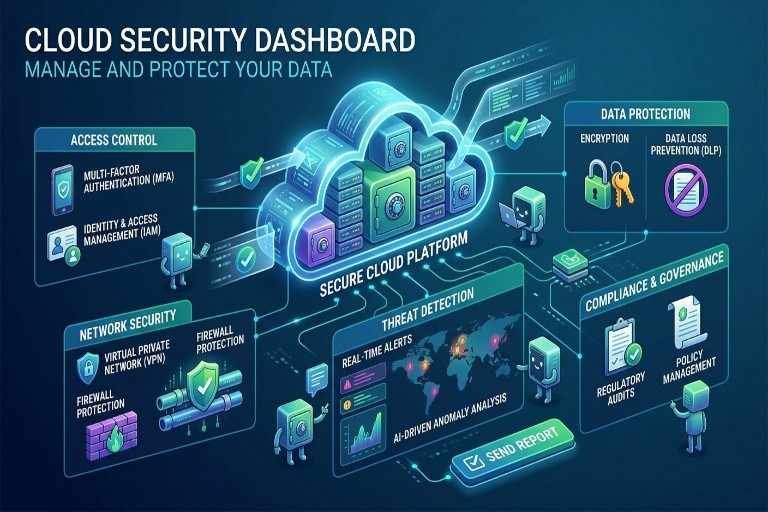
As organizations continue migrating applications, databases, and workloads to cloud platforms, cloud security has become one of the most critical priorities for businesses of all sizes. Whether using public, private, or hybrid cloud environments, protecting sensitive information from cyber threats is essential. In 2026, the rapid adoption of artificial intelligence, multi-cloud deployments, and remote work has made cloud environments more complex than ever, increasing the need for stronger security strategies.
Cloud security is the practice of protecting cloud-based systems, applications, data, and infrastructure from unauthorized access, cyberattacks, and data breaches. It combines advanced technologies, security policies, and continuous monitoring to ensure cloud resources remain secure while maintaining business continuity.
Why Cloud Security Matters More Than Ever
Modern businesses rely on cloud services to store customer information, run business applications, and support remote teams. While cloud platforms offer scalability and flexibility, they also introduce new security challenges. Misconfigured cloud settings, weak user authentication, exposed APIs, and insider threats continue to be among the leading causes of cloud security incidents.
Cybercriminals increasingly target cloud environments because they often contain valuable business data. A single security misconfiguration can expose confidential information, leading to financial losses, compliance violations, and damage to an organization’s reputation.
Cloud Encryption: Protecting Sensitive Data
Encryption remains one of the strongest defenses in cloud security. It converts sensitive information into unreadable data that can only be accessed with the correct encryption keys. Organizations should encrypt data both while it is stored (data at rest) and while it is being transferred between systems (data in transit).
Many cloud providers now offer built-in encryption services, but businesses should also manage encryption keys carefully using secure key management solutions. Proper encryption ensures that even if attackers gain access to stored data, the information remains protected.
Identity and Access Management (IAM)
Identity and Access Management (IAM) has become a cornerstone of cloud security. IAM ensures that only authorized users have access to cloud resources based on their roles and responsibilities.
Best IAM practices include:
- Enabling Multi-Factor Authentication (MFA) for all user accounts.
- Following the Principle of Least Privilege (PoLP), granting users only the permissions they need.
- Using Role-Based Access Control (RBAC) to simplify permission management.
- Regularly reviewing user accounts and removing inactive users.
- Implementing Single Sign-On (SSO) for secure and centralized authentication.
Strong IAM significantly reduces the risk of unauthorized access caused by stolen passwords or compromised user accounts.
Continuous Cloud Monitoring
Cloud security is no longer limited to preventing attacks—it also requires continuous monitoring and rapid incident detection. Modern security platforms use AI-powered analytics to monitor cloud infrastructure in real time and identify unusual activities.
Continuous monitoring helps organizations detect:
- Unauthorized login attempts
- Suspicious user behavior
- Misconfigured cloud resources
- Malware infections
- Data exfiltration attempts
- Compliance violations
Security Information and Event Management (SIEM) platforms, Cloud Security Posture Management (CSPM), and Extended Detection and Response (XDR) solutions are increasingly being adopted to improve cloud visibility and reduce response times.
Securing Multi-Cloud Environments
Many organizations now use services from multiple cloud providers to improve flexibility and reduce dependency on a single vendor. While multi-cloud strategies offer several business advantages, they also introduce security complexities.
Organizations should maintain consistent security policies across all cloud platforms, automate compliance checks, and regularly audit cloud configurations. Centralized security dashboards help IT teams monitor multiple cloud environments from a single interface.
AI-Powered Cloud Security
Artificial Intelligence is transforming cloud security by improving threat detection and automating security operations. AI can quickly analyze millions of security events, identify abnormal behavior, and respond to potential threats much faster than manual processes.
Machine learning algorithms continuously learn from previous attacks, enabling organizations to detect emerging threats before they cause significant damage. Automated security responses also reduce the workload on cybersecurity teams and minimize human error.