


 By
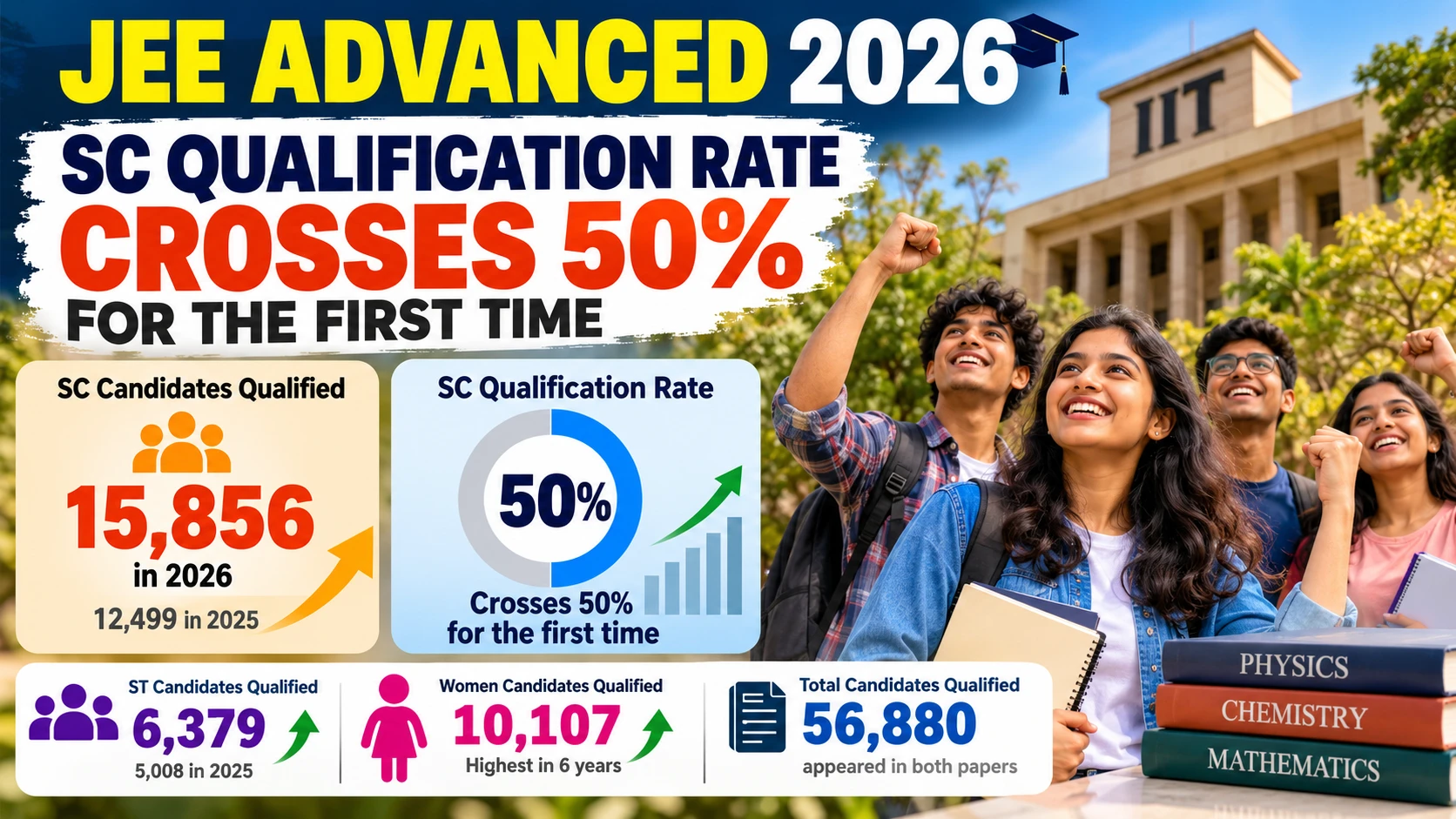
By The JEE Advanced 2026 results have brought a significant change in the demographic profile of students qualifying for one of India’s most competitive engineering entrance examinations. For the first time, the qualification rate among Scheduled Caste (SC) candidates crossed the 50% mark, highlighting a major shift in the representation of historically underrepresented communities in India’s premier engineering education system.
According to the JEE Advanced 2026 results and the Joint Implementation Committee report released by IIT Roorkee, a total of 56,880 candidates qualified this year after appearing in both papers. Among them were 15,856 SC candidates and 6,379 Scheduled Tribe (ST) candidates. The number of SC qualifiers has increased substantially compared with 2025, when 12,499 SC candidates qualified.
SC Qualification Rate Crosses 50%
One of the biggest highlights of JEE Advanced 2026 is the improvement in the SC category qualification rate. The qualification rate among SC candidates crossed 50% for the first time, marking an important development in the examination’s history.
The official data shows that 31,613 SC candidates registered without PwD status, while 29,786 appeared in both papers. Of these, 15,817 qualified. An additional 39 SC-PwD candidates qualified, taking the overall number of SC qualifiers to 15,856.
This represents a significant increase compared with the previous year. In 2025, 12,499 SC candidates qualified, whereas the number increased to 15,856 in 2026. This is an increase of more than 3,300 candidates in just one year.
The rise has attracted attention because JEE Advanced is the gateway to undergraduate programmes at the Indian Institutes of Technology (IITs), which are among India’s most prestigious engineering institutions.
ST Candidates Also See Strong Growth
The improvement was not limited to the SC category. ST candidates also recorded a substantial increase in successful candidates.
In 2026, 6,379 ST candidates qualified, compared with 5,008 in 2025. This represents an increase of roughly 27% in the number of successful candidates.
The increase in the number of SC and ST candidates qualifying means that students from these communities now account for a substantial share of the total qualified pool.
The trend is being viewed as an important indicator of changing access to India’s premier engineering education system. However, qualification is only the first step. Students still need to participate in the JoSAA counselling and seat-allocation process to secure admission to IITs or other participating institutions.
Overall JEE Advanced 2026 Results
JEE Advanced 2026 was conducted on May 17, 2026, in two papers. According to the official results, 1,87,389 candidates registered for the examination.
Of these, 1,79,694 candidates appeared in both Paper 1 and Paper 2, while 56,880 candidates qualified.
The examination was conducted by IIT Roorkee, which served as the organising institute for JEE Advanced 2026.
The Common Rank List was topped by Shubham Kumar of the IIT Delhi zone, who scored 330 marks out of 360. The highest-ranked female candidate was Arohi Deshpande, who secured All India Rank 77 with 280 marks.
These results demonstrate the intense competition involved in securing an IIT seat. Even after clearing JEE Main and becoming eligible for JEE Advanced, students must perform exceptionally well in both papers to enter the final rank lists.
Women Candidates Reach a Six-Year High
Another major highlight of JEE Advanced 2026 is the increasing number of women candidates qualifying for the examination.
A total of 43,112 female candidates registered for JEE Advanced 2026. Of these, 40,562 appeared in both papers, and 10,107 women qualified.
This is the first time in six years that the number of female candidates qualifying for JEE Advanced has crossed the 10,000 mark.
The qualification rate among registered female candidates increased from 21.7% in 2025 to 23.4% in 2026.
The increase is particularly important because engineering education in India has historically seen lower participation by women compared with men.
To improve women’s representation in IITs, 3,814 female-only seats, including female supernumerary seats, were allotted in 2026. In addition, 37 female candidates secured seats through the gender-neutral pool, according to the Joint Implementation Committee report.
General Category Sees a Different Trend
While SC, ST and women candidates recorded notable increases, the General category showed a different pattern.
The number of General category candidates qualifying declined from 16,154 in 2025 to 15,883 in 2026. The qualification rate also declined from around 43% to 39.8%.
The OBC-NCL category also recorded a lower qualification rate compared with the previous year.
These differences demonstrate that the JEE Advanced results are not simply about the total number of students qualifying. Category-wise qualification rates can change significantly depending on examination performance, qualifying criteria and the distribution of candidates.
Why Is the SC Qualification Rate Important?
The 50% milestone is significant because IIT admissions have long been part of the wider discussion surrounding educational access, social representation and equal opportunity.
JEE Advanced has a highly competitive selection process. Candidates must first qualify through JEE Main and then meet the eligibility requirements for JEE Advanced. The 2026 eligibility rules provided category-wise representation among candidates shortlisted from JEE Main, including 15% for SC and 7.5% for ST candidates, with horizontal reservation provisions for PwD candidates.
JEE Advanced also uses category-specific qualifying criteria. The official information brochure states that candidates belonging to categories such as GEN-EWS, OBC-NCL, SC, ST and PwD can be declared qualified on the basis of relaxed criteria.
Therefore, the increase in SC qualification should be understood within the broader framework of category-wise eligibility and qualifying rules.
Qualification Does Not Guarantee an IIT Seat
Students and parents should also remember that qualifying JEE Advanced does not automatically guarantee admission to an IIT.
After the examination results, qualified candidates must participate in the Joint Seat Allocation Authority (JoSAA) counselling process. They need to fill their preferred institutes and programmes, after which seats are allocated according to rank, category, preferences, availability and other admission rules.
For 2026, the official JEE Advanced website confirmed that JoSAA registration and choice filling were required for qualified candidates seeking IIT admission.
Students must therefore distinguish between three different stages: qualifying JEE Main, qualifying JEE Advanced and finally securing an IIT seat through counselling.
A Changing Picture of Engineering Education
The JEE Advanced 2026 results provide a broader picture of changing participation in India’s engineering education system.
The increase in SC and ST qualifiers indicates stronger representation of students from historically underrepresented communities. At the same time, the record number of women qualifying shows that female participation in the country’s most competitive engineering entrance examination is gradually increasing.
However, the numbers should not be viewed only as a statistical achievement. The larger question is whether these improvements translate into greater representation inside IIT classrooms, laboratories, research programmes and eventually the technology workforce.
Increasing access to high-quality coaching, better school education, scholarships, digital learning resources and academic support can play an important role in sustaining these trends.
What JEE Advanced 2026 Means for Future Aspirants
For students preparing for JEE Advanced 2027 and beyond, the results offer several lessons.
First, the examination remains extremely competitive, with more than 1.79 lakh candidates appearing in both papers and only 56,880 qualifying in 2026.
Second, students should not depend only on qualifying marks. A strong rank is essential for gaining access to highly demanded IIT branches.
Third, category-specific rules can influence qualification, but students still need serious preparation in Physics, Chemistry and Mathematics.
Finally, the rising participation of women and candidates from SC and ST communities demonstrates that IIT-level engineering education is becoming accessible to a broader group of students.
Conclusion
The JEE Advanced 2026 results mark an important moment in India’s engineering education landscape. For the first time, the SC qualification rate crossed the 50% mark, while the number of SC qualifiers rose to 15,856, up from 12,499 in 2025. ST qualifiers also increased to 6,379, while 10,107 women qualified, the highest number in six years.
The figures point toward growing diversity among students entering the highly competitive IIT admission pipeline. At the same time, they highlight the continuing importance of academic preparation, equal access to educational resources and effective support systems.
As India expands its focus on technology, engineering, innovation and research, greater representation across gender and social categories could play an important role in shaping the country’s future talent pool.
For thousands of JEE aspirants, the 2026 results are more than just numbers. They represent a changing competitive landscape—and a reminder that the path to India’s premier engineering institutions is becoming increasingly diverse.
Follow Us On Instagram.