

 By
Introduction
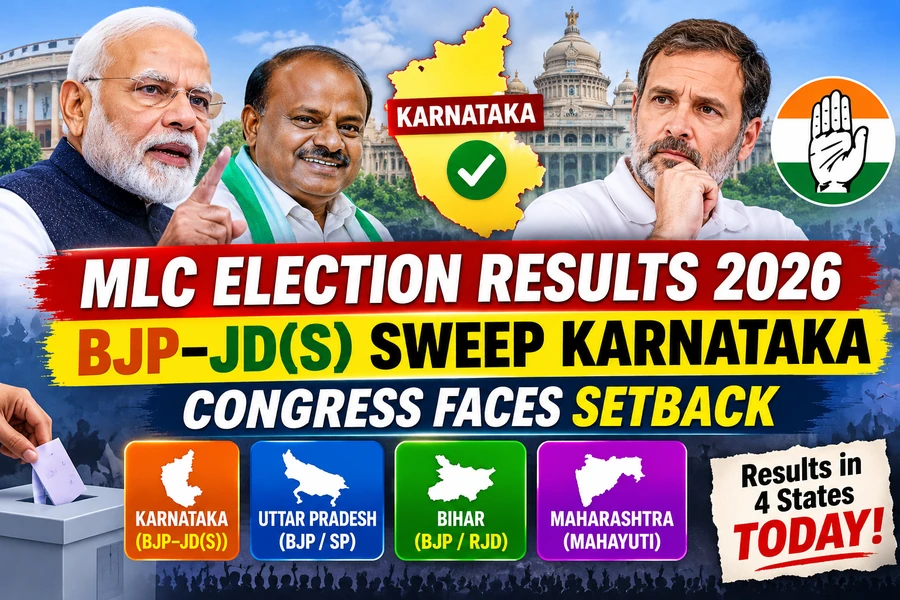
The latest Legislative Council election results have delivered a political setback to the Congress party, with the party failing to win any of the 28 seats contested across Karnataka, Uttar Pradesh, Bihar and Maharashtra. The biggest blow came from Karnataka, where the BJP–Janata Dal (Secular) alliance won all four seats, including a constituency previously represented by a Congress MLC.
The results have drawn attention to the performance of political parties in these states and the strength of their local electoral networks. For the Congress, the outcome raises questions about its ability to mobilise support among professional voters, particularly in Karnataka, where it is in power.
However, these elections involve specific groups of registered graduates and teachers rather than the entire electorate. Therefore, the results should be viewed in their electoral context rather than as a direct verdict on public opinion across all four states.
BJP–JD(S) Alliance Delivers a Strong Performance in Karnataka
Karnataka emerged as the centre of attention after the BJP and JD(S) alliance secured victories in all four Legislative Council constituencies. The outcome represents a significant setback for the Congress government and provides a boost to the opposition alliance.
The four constituencies included the North-East Teachers’, West Graduates’, South-East Graduates’ and Bengaluru Teachers’ seats. BJP candidates won three constituencies, while the JD(S) secured the Bengaluru Teachers’ seat.
One of the notable contests took place in Bengaluru, where JD(S) candidate A. P. Ranganath defeated sitting Congress MLC Puttanna by 908 votes. Ranganath received 10,810 votes against Puttanna’s 9,902, according to India Today.
The result was particularly significant because Congress lost a seat it had previously held. It also demonstrated the importance of coordination between opposition parties in constituencies where local networks and candidate outreach can influence the outcome.
Why the Results Matter for the Congress Party
The Congress party’s failure to win any of the 28 contested seats has put its electoral organisation under scrutiny. The setback in Karnataka is especially important because the party governs the state and had campaigned to retain support among teachers and graduates.
The results may prompt discussions within the party about campaign strategy, candidate selection and its engagement with professional groups.
Nevertheless, the outcome should not automatically be interpreted as a prediction of the next Assembly election. Legislative Council elections involving graduate and teacher constituencies have a narrower electorate and can be influenced by local issues, candidate popularity and alliance arrangements.
BJP and JD(S) Gain Momentum Ahead of Future Elections
The Karnataka victory offers the BJP–JD(S) alliance a morale boost as both parties prepare for future political contests in the state.
The alliance’s coordinated performance suggests that cooperation between the two parties can be electorally effective in selected constituencies. It also gives opposition leaders an opportunity to challenge the Congress government’s political narrative.
For the BJP, the results provide an opportunity to highlight the alliance’s performance. For the JD(S), winning the Bengaluru Teachers’ constituency strengthens its position among a specific segment of Karnataka’s electorate.
Whether this momentum translates into broader electoral gains will depend on future campaigns, local political developments and voter priorities.
What Happened in Uttar Pradesh, Bihar and Maharashtra?
The Legislative Council contests also covered Uttar Pradesh, Bihar and Maharashtra, where political competition involves different parties, alliances and regional dynamics.
In Uttar Pradesh, the BJP and Samajwadi Party were among the main competitors. The BJP retained several constituencies, while the Samajwadi Party won some teachers’ seats. The emerging results reflected the continuing contest between the state’s major political forces.
Bihar’s results showed a more fragmented political picture, with victories involving parties such as the BJP and Rashtriya Janata Dal, alongside an important result for Prashant Kishor’s Jan Suraaj Party in Darbhanga.
In Maharashtra, the five constituencies involved competition between the ruling Mahayuti alliance and the opposition Maha Vikas Aghadi. Counting was still ongoing in several seats at the time of reporting, so the final state-wise outcome should be checked against the latest official declarations.
The results across the three states show why local political conditions matter. The performance of a party in one state does not necessarily translate into the same outcome elsewhere.
Understanding Graduate and Teacher Constituency Elections
Legislative Council elections in graduate and teacher constituencies differ from regular Assembly elections. Eligible voters belong to specific registered groups, and candidates often rely on direct outreach, professional associations and established local networks.
The voting process also uses preferential ballots, which can make counting more complex than a straightforward first-past-the-post contest.
As a result, these elections can reveal the strength of candidates and parties among particular professional groups without necessarily reflecting the preferences of the wider population.
For political parties, however, the results remain important because they offer an opportunity to evaluate organisational strength, voter engagement and alliance coordination.
What Could Happen Next?
The Congress party may face questions about its strategy following the results, especially in Karnataka. Party leaders could review their campaign approach and consider how to strengthen connections with teachers, graduates and other organised voter groups.
Meanwhile, the BJP and JD(S) may use their Karnataka victories to build momentum and strengthen cooperation ahead of future elections.
The results in Uttar Pradesh, Bihar and Maharashtra will also remain relevant as parties assess their regional performance and prepare for upcoming political contests.
No immediate change to the Karnataka government’s position follows from these MLC results alone. The elections are an important political signal, but they do not determine the government’s Assembly majority.
Conclusion
The October 2026 Legislative Council election results have given the BJP–JD(S) alliance a significant victory in Karnataka while highlighting the Congress party’s difficulties across four states.
The alliance’s sweep of all four Karnataka seats is the most notable outcome, particularly because Congress lost a constituency previously held by the party. At the same time, the specialised electorate in graduate and teacher constituencies means that the results must be interpreted carefully.
The wider political impact will depend on how parties respond, whether alliances remain effective and how these results influence their preparations for future elections.
Sources:
- India Today — Congress wins zero seats in MLC polls across four states
- The Times of India — MLC election results: BJP, SP trade wins as Congress faces setback
Editorial note: Election figures and state-wise outcomes may change as counting concludes and official results are confirmed. This article distinguishes the reported results from broader political interpretations.
Follow Us On Instagram