

 By
Introduction
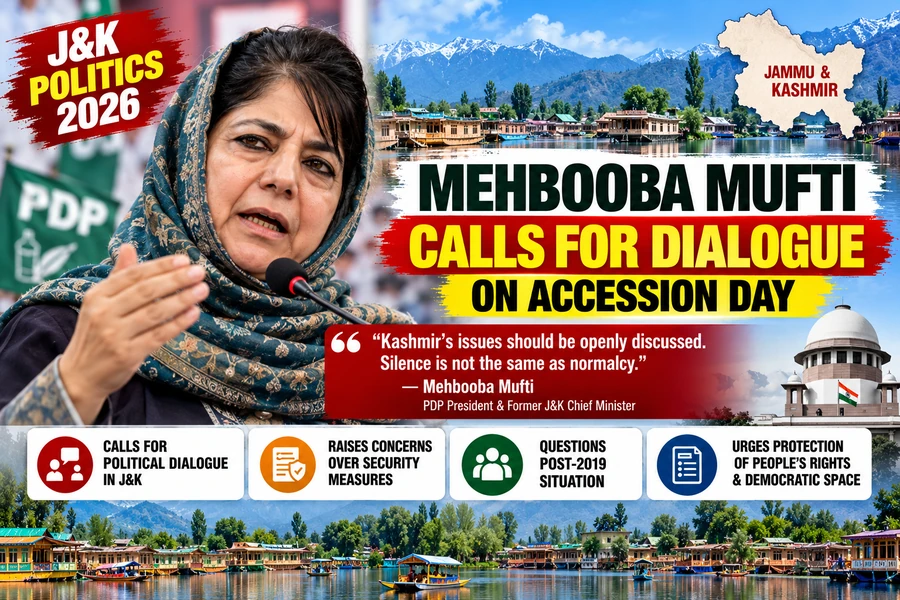
Jammu and Kashmir politics returned to the spotlight on October 26, 2026, as Peoples Democratic Party (PDP) president and former Chief Minister Mehbooba Mufti called for greater political dialogue and public discussion about the region’s future. Speaking at a party gathering in Srinagar on Accession Day, Mufti criticised the BJP-led government’s approach to Jammu and Kashmir, alleging that security measures and restrictions were being prioritised over democratic engagement.
Her remarks focused on the circumstances surrounding Jammu and Kashmir’s accession to India in 1947, the constitutional changes introduced in 2019, and the concerns she says continue to affect the region’s residents. The statements have renewed attention on the longstanding political differences between regional parties and the Centre over governance, civil liberties and the future political framework of Jammu and Kashmir.
Source: The Indian Express and United News of India (UNI).
Mehbooba Mufti Calls for Open Discussion on Kashmir
Addressing party members and supporters, Mufti argued that Kashmir is frequently discussed in national and international political forums, but that people within the Union Territory should also have meaningful opportunities to discuss their political concerns openly.
She alleged that the prevailing political atmosphere discourages public expression and that restrictions should not automatically be interpreted as evidence of peace or normalcy. According to her, a lasting solution requires direct engagement with residents, attention to public grievances and opportunities for democratic participation.
Mufti urged people across India to understand the region’s political concerns and called for an approach that prioritises dialogue, trust and constitutional principles.
These statements reflect the PDP president’s political position. The government’s perspective and the views of other political parties differ on several of these issues.
Accession Day and Its Historical Significance
October 26 is observed as Accession Day in Jammu and Kashmir, commemorating the signing of the Instrument of Accession by Maharaja Hari Singh in 1947. The instrument formalised the erstwhile princely state’s accession to India; it was accepted by the then Governor-General, Lord Mountbatten, on October 27, 1947.
The events unfolded during the turmoil surrounding Partition. Following an invasion by tribal forces backed by Pakistan, Maharaja Hari Singh sought military assistance from India and signed the Instrument of Accession.
The anniversary continues to carry political and historical significance. Different political groups interpret the accession, the constitutional arrangements that followed, and the region’s relationship with the Union government in different ways.
Mufti used the occasion to argue that the relationship was built on trust and the expectation that Jammu and Kashmir’s distinctive identity and interests would be respected.
Article 370 Remains at the Centre of Political Debate
One of the key themes in Mufti’s address was the Centre’s decision in August 2019 to revoke Jammu and Kashmir’s special constitutional status under Article 370 and reorganise the former state into two Union Territories: Jammu and Kashmir, and Ladakh.
The decision marked a major constitutional and administrative change. It remains a central issue in regional politics, with parties such as the PDP arguing that the changes weakened the region’s political autonomy and safeguards.
The BJP and its supporters have defended the changes as a step towards greater integration, uniform governance and development. Regional opposition parties have raised concerns about political representation, local identity, civil liberties and the restoration of statehood.
Mufti reiterated her party’s objections to the 2019 changes, arguing that the political relationship between Jammu and Kashmir and the Union government needs renewed attention.
Concerns Over Security Measures and Civil Liberties
Mufti also raised concerns about arrests, raids, police scrutiny, travel restrictions and difficulties that some residents allegedly face when seeking passports for education or employment.
She argued that security measures should not replace political engagement and that residents should be able to express their views and participate in public life without undue restrictions.
These allegations form part of the PDP’s criticism of the prevailing approach to governance in Jammu and Kashmir. Individual claims about specific restrictions or cases should be assessed against official records and independently verified reporting.
The broader debate highlights the challenge of balancing security requirements with civil liberties, public confidence and democratic participation in a region that has experienced decades of political tension and security challenges.
Why Political Dialogue Matters
Political dialogue is a recurring issue in discussions about Jammu and Kashmir. Supporters of renewed engagement argue that sustained communication between the Centre, regional parties and residents could help address grievances and rebuild trust.
Opposing political perspectives differ on the appropriate framework for such engagement, including the future of statehood, constitutional arrangements, security policy and the role of elected institutions.
Mufti’s latest remarks underline the PDP’s position that political problems require political solutions. Her appeal for dialogue also places renewed emphasis on public participation and the need to address the concerns of young people and other residents.
Whether the comments lead to any formal political initiative remains unclear. No new government decision should be inferred from the speech alone.
Jammu and Kashmir’s Political Landscape
The political debate in Jammu and Kashmir involves several major parties with differing positions on autonomy, constitutional status, governance and relations with the Centre.
The National Conference, the PDP, the BJP and other political groups have presented contrasting interpretations of the region’s history and future. While some parties focus on restoring statehood and addressing the effects of the 2019 changes, the BJP has defended the constitutional reorganisation.
These differences mean that major anniversaries and public speeches frequently become opportunities for parties to restate their positions and appeal to voters.
Mufti’s Accession Day address is part of this continuing political discussion. Its significance lies in the renewed emphasis on historical assurances, political rights and the role of dialogue in resolving disagreements.
What Could Happen Next?
Mufti’s remarks may keep issues such as political dialogue, statehood, constitutional protections and civil liberties in public discussion. However, the speech itself does not establish that any policy change or formal negotiations have been announced.
Further developments will depend on statements from the Union government, the Jammu and Kashmir administration and regional political parties. Any new proposals or official decisions should be assessed on the basis of confirmed announcements.
For residents, the key questions remain how political representation will evolve, how public concerns will be addressed and what role dialogue will play in shaping the region’s future.
Conclusion
Mehbooba Mufti’s October 26 address has brought Jammu and Kashmir’s political concerns back into focus on Accession Day. By highlighting the history of accession, opposing the 2019 constitutional changes and calling for greater dialogue, the PDP president has reiterated her party’s demand for a more politically engaged approach to the region.
The remarks reflect continuing differences between regional opposition parties and the Centre over constitutional arrangements, security and democratic rights. The next stage of this debate will depend on how political leaders respond and whether the call for dialogue translates into concrete discussions or policy measures.
Follow Us On Instagram