

 By
By Physical Security in 2026: Protecting People, Property and Infrastructure in a Smart World
As organizations become increasingly digital, physical security remains a fundamental part of protecting people, property, equipment, and critical infrastructure. Cybersecurity may protect digital systems from online threats, but physical security protects the real-world environments where employees work, servers operate, and valuable assets are stored.
From traditional locks and security guards to AI-powered CCTV cameras and biometric access control, physical security is rapidly evolving. In 2026, organizations are increasingly combining physical protection with smart technologies to create a layered and more responsive security environment.
What Is Physical Security?
Physical security includes the technologies, procedures, and controls used to prevent unauthorized physical access, theft, vandalism, accidents, and damage to buildings and assets.
It can include locks, security guards, CCTV cameras, fire alarms, fences, access-control systems, security lighting, biometric authentication, and visitor management systems.
A strong physical security strategy does not depend on one measure. Instead, multiple layers work together to prevent, detect, delay, and respond to potential threats.
1. Smart Locks and Access Control
Locks are one of the oldest forms of physical security, but modern access control has become significantly more sophisticated.
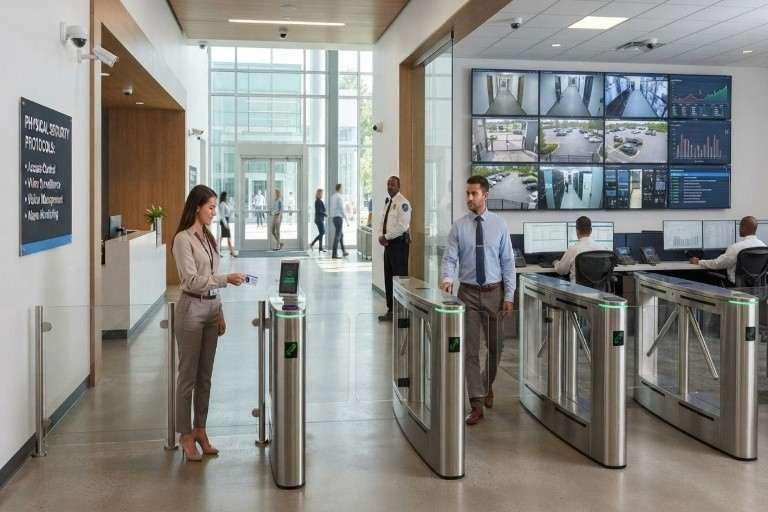
Organizations can use electronic locks, access cards, PINs, mobile credentials, and smart access-control systems to restrict entry to specific areas.
Modern systems can also maintain access logs, allowing security teams to determine who entered a particular location and when.
Instead of providing every employee with unrestricted access, organizations can implement role-based physical access. For example, only authorized IT personnel may be permitted to enter a server room, while other employees can access common office areas.
2. CCTV and AI-Powered Surveillance
CCTV cameras are among the most widely used physical security technologies.
Modern surveillance systems can provide high-resolution video, night vision, motion detection, remote monitoring, and automated alerts. Increasingly, AI-powered video analytics are being used to identify unusual activity and help security teams focus on events that require attention.
For example, intelligent surveillance can assist in detecting unauthorized entry, unusual movement, or activity in restricted areas.
However, organizations should implement surveillance responsibly, considering privacy requirements, data protection, retention policies, and appropriate access to recorded footage.
3. Security Guards and Human Oversight
Technology provides valuable capabilities, but trained security personnel remain essential.
Security guards can verify visitors, monitor entrances, respond to incidents, patrol facilities, and make decisions in situations that automated systems may not fully understand.
The most effective approach is often to combine human expertise with technology. Security personnel can use CCTV feeds, access-control alerts, communication systems, and other tools to respond more quickly to potential incidents.
4. Fire Alarms and Emergency Protection
Physical security is not limited to preventing unauthorized access. Protecting people and facilities from fires and other emergencies is equally important.
Fire alarms, smoke detectors, emergency lighting, fire suppression systems, evacuation plans, and emergency communication systems can help reduce the impact of incidents.
Organizations should regularly test their fire and safety systems and ensure employees understand emergency procedures.
A security system that works during normal conditions but fails during an emergency can create significant risks.
5. Fences and Perimeter Security
Perimeter security creates the first physical barrier between a facility and potential intruders.
Fences, gates, barriers, security lighting, vehicle-control systems, and surveillance cameras can help protect the boundaries of a property.
For facilities such as warehouses, data centers, manufacturing plants, and critical infrastructure sites, perimeter protection can be particularly important.
Modern perimeter security can also combine sensors and surveillance systems to detect activity around restricted areas.
6. Biometric Building Access
Biometric authentication is becoming increasingly common in modern buildings.
Fingerprint scanners, facial recognition, iris recognition, and other biometric technologies can verify an individual’s identity using unique physical characteristics.
Biometrics can reduce dependence on physical keys or access cards, which can be lost, stolen, or shared.
However, biometric systems must be implemented carefully. Organizations should consider privacy, data protection, accuracy, secure storage, and appropriate fallback authentication methods.
7. Physical Security and Cybersecurity Are Connected
One of the major security trends in 2026 is the increasing connection between physical and digital security.
Modern access-control systems, CCTV cameras, smart locks, sensors, and building-management systems may be connected to corporate networks or cloud platforms.
This creates new opportunities for centralized monitoring but also introduces cybersecurity risks. If a connected security device is compromised, attackers could potentially use it as an entry point into other systems.
Organizations should therefore protect physical security devices with strong authentication, secure network configurations, software updates, access controls, and continuous monitoring.
The Future of Physical Security
Physical security is becoming more intelligent, connected, and data-driven.
AI-assisted surveillance, cloud-based access control, mobile credentials, smart sensors, automated alerts, and integrated security platforms are helping organizations improve visibility and response times.
At the same time, security teams must balance technology with human oversight. Automation can help identify potential threats, but trained professionals are still needed to investigate incidents and make appropriate decisions.
The future of physical security will increasingly involve a layered security model where physical barriers, technology, people, and cybersecurity work together.