


 By
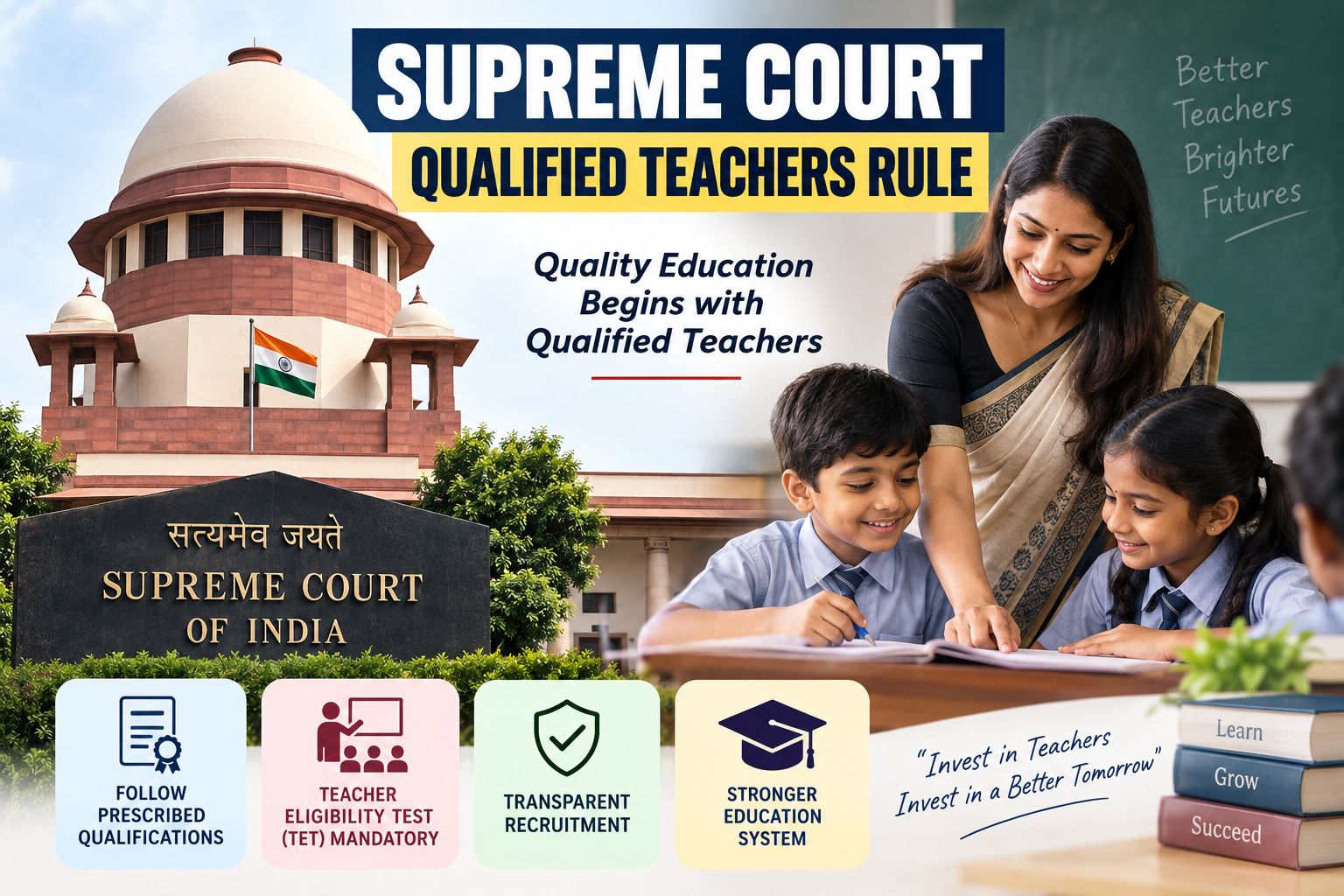
By The Supreme Court of India has recently reinforced the importance of qualified teachers in schools and colleges, making it clear that educational institutions cannot appoint or continue teachers who do not meet the qualifications prescribed under the applicable laws and regulatory frameworks. The development is significant because it places teacher quality, proper recruitment and prescribed educational standards at the centre of the education system.
Supreme Court’s Stand on Qualified Teachers
The Supreme Court has directed, as an interim measure, that teachers should not be appointed or continued in schools and colleges unless they possess the qualifications prescribed under the relevant statutory framework. The Court referred particularly to the Right of Children to Free and Compulsory Education (RTE) Act, 2009, National Council for Teacher Education (NCTE) regulations and University Grants Commission (UGC) requirements.
The order came in proceedings concerning schemes that could allow teachers and other employees of educational institutions to enter government service without undergoing a fair, transparent and competitive recruitment process. The Supreme Court’s intervention highlights that government employment in education cannot be used as a route to bypass legally prescribed qualifications.
Why Teacher Qualification Matters
Teachers have a direct influence on the academic development, skills and overall growth of students. A teacher is not simply responsible for delivering lessons but also plays an important role in developing students’ understanding, discipline, confidence and critical-thinking abilities.
The Supreme Court has repeatedly emphasized that quality education requires qualified teachers. The objective behind minimum qualification requirements is therefore not merely administrative. It is connected with the larger constitutional goal of ensuring quality education for children.
The RTE Act provides the legal framework for minimum teacher qualifications in schools covered by the Act. The NCTE, as the national regulatory body for teacher education, prescribes minimum qualification standards and oversees teacher education institutions.
Teacher Eligibility Test (TET) and Its Importance
One of the most important aspects of the Supreme Court’s approach to teacher qualification is the Teacher Eligibility Test (TET).
In its September 1, 2025 judgment in Anjuman Ishaat-e-Taleem Trust v. State of Maharashtra, the Supreme Court held that TET is a minimum qualification under Section 23 of the RTE Act and is mandatory for appointment as a teacher in schools covered by the Act. The Court treated TET as more than a simple eligibility condition; it forms part of the minimum qualification required for teaching.
The judgment also recognized that there are teachers who were appointed before the RTE Act came into force and who had already served for many years. Therefore, the Court provided certain relief for eligible in-service teachers while maintaining the principle that prescribed qualifications cannot simply be ignored.
Teachers appointed before the RTE Act who had less than five years of service remaining were allowed to continue until retirement without passing TET. However, they would not be eligible for promotion unless they qualified in TET. Teachers with more than five years remaining were required to acquire the qualification within the time permitted by the Court.
Extension of TET Qualification Deadline
The Supreme Court subsequently reviewed the matter in 2026 and extended the deadline for eligible teachers to acquire TET qualification.
According to the Ministry of Education, the Supreme Court’s May 29, 2026 judgment extended the deadline from August 31, 2027, to August 31, 2028. The Court also observed that the appropriate authorities should endeavour to conduct TET examinations periodically, preferably twice a year, giving teachers reasonable opportunities to meet the qualification requirement.
This is important for teachers who are already working but need to fulfil the TET requirement. It gives them additional time while maintaining the long-term objective of establishing uniform qualification standards.
Impact on Schools and Colleges
The latest Supreme Court direction has important implications for educational institutions. Schools and colleges are expected to follow the qualifications prescribed by the appropriate statutory authorities when recruiting teachers.
Institutions cannot simply appoint individuals because they have teaching experience or have worked in a private educational institution. Experience can be valuable, but it cannot automatically replace mandatory statutory qualifications.
For schools covered by the RTE framework, qualifications prescribed through the RTE Act and NCTE regulations are particularly important. For higher education institutions, the applicable UGC regulations and other statutory requirements continue to govern teacher appointments.
The ruling therefore strengthens the principle that teacher recruitment must be based on prescribed qualifications, transparency and appropriate selection procedures.
Message for Teachers
For teachers and teaching aspirants, the development sends a clear message: obtaining the required academic and professional qualifications is essential for a career in education.
Candidates planning to enter teaching should carefully check the qualification requirements applicable to the level and type of school or institution where they intend to work. Depending on the post, requirements may include qualifications such as D.El.Ed., B.Ed., graduation or other recognized teacher-training qualifications, along with TET wherever applicable. NCTE maintains official notifications relating to minimum teacher qualifications.
Existing teachers should also verify whether they are required to obtain TET or any other qualification under the rules applicable to their appointment.
Importance for Students
Ultimately, the Supreme Court’s focus is on protecting the interests of students. When teachers possess appropriate academic and professional training, students are more likely to receive structured, effective and quality instruction.
A properly qualified teacher is better equipped to understand curriculum requirements, use appropriate teaching methods, evaluate students and respond to different learning needs. Strong teacher standards can therefore contribute to better educational outcomes.
The ruling also reinforces the idea that the right to education should not be understood merely as access to a classroom. The quality of teaching provided inside that classroom is equally important.
Transparency in Teacher Recruitment
Another important issue highlighted by the Supreme Court is the need for fair and transparent recruitment.
Teacher appointments to government institutions involve public resources and directly affect students. Therefore, recruitment should follow established eligibility criteria and competitive procedures rather than allowing unqualified individuals to obtain government positions through special arrangements.
This approach can also improve public confidence in the education system by ensuring that teaching positions are awarded on the basis of qualifications and merit.
Conclusion
The Supreme Court’s recent directions underline a simple but important principle: students deserve qualified teachers, and educational institutions must respect legally prescribed teacher qualifications.
The emphasis on RTE, NCTE and UGC standards demonstrates the Court’s commitment to maintaining minimum professional standards in education. The mandatory role of TET, along with the additional time granted to eligible in-service teachers, attempts to balance two objectives—protecting the careers of existing teachers while ensuring quality education for students.
For aspiring teachers, the message is clear: proper academic qualifications, recognized teacher-training credentials and TET wherever required are increasingly important for appointment and promotion. For schools and colleges, the ruling reinforces the responsibility to recruit only eligible and appropriately qualified educators.
In the long run, maintaining qualified teaching staff can strengthen India’s education system and help ensure that every child receives not only the right to attend school but also the right to quality education from competent teachers.
Follow Us On Instagram