

 By
Introduction
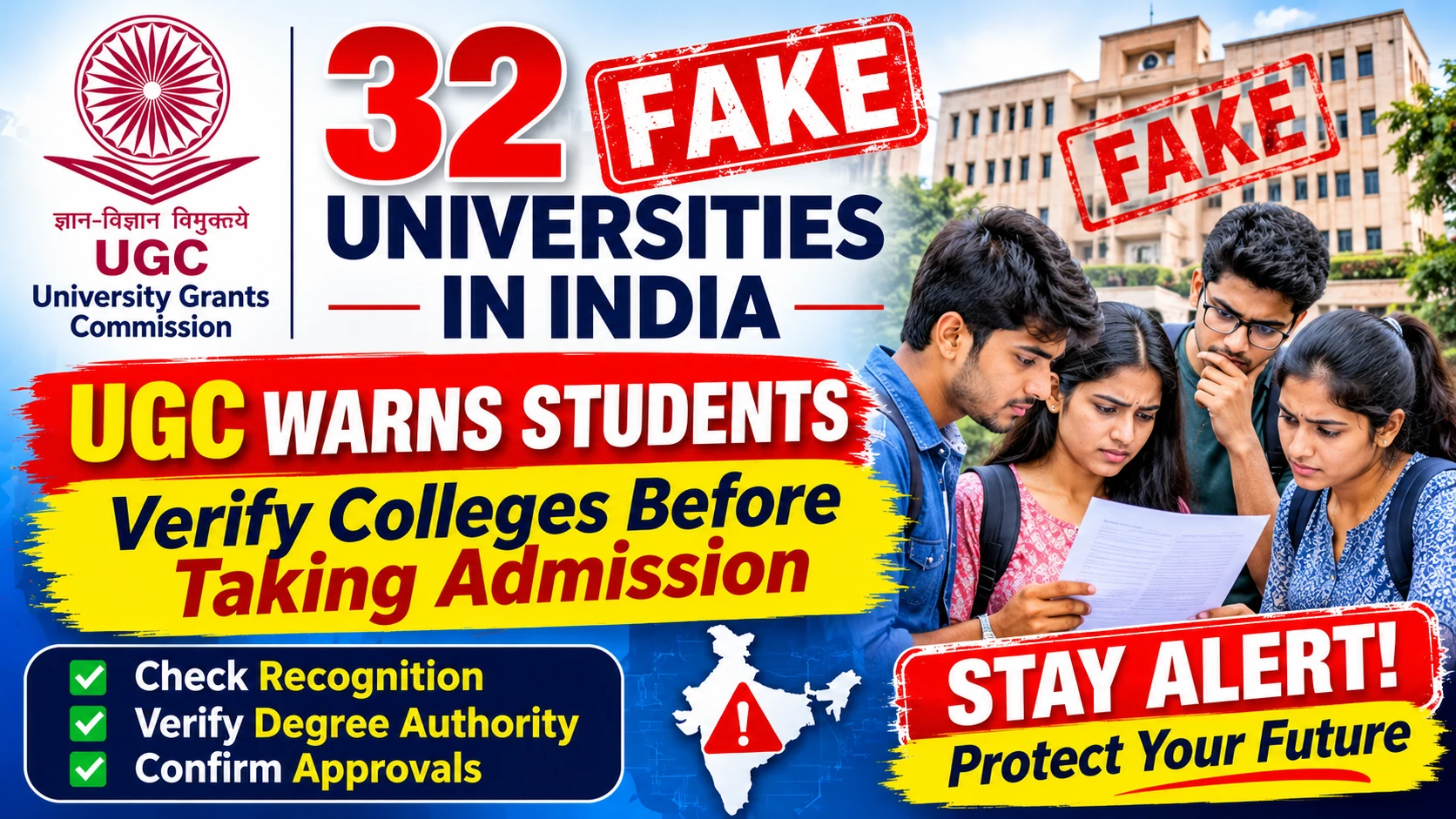
The University Grants Commission (UGC) has issued an important warning to students, parents and guardians across India regarding fake universities and educational institutions operating without proper legal recognition. The commission has advised everyone to verify the authenticity and recognition status of educational institutions before applying for admission or making any academic or financial commitments.
According to the latest UGC list published in February 2026, a total of 32 institutions have been identified as fake universities across 12 states and Union Territories. The latest public advisory, dated November 17, 2026, further highlights the importance of checking institutional recognition, course approvals and degree-awarding authority before choosing a college.
This announcement is particularly important for students preparing for undergraduate and postgraduate admissions, as selecting an unrecognised institution can create serious problems for their future education and employment opportunities.
UGC Identifies 32 Fake Universities Across India
The University Grants Commission periodically monitors educational institutions to ensure that universities operate according to applicable regulations.
As part of its efforts to protect students, the UGC has published a state-wise list identifying 32 institutions that are operating as fake universities.
These institutions do not have the necessary legal authority to function as recognised universities or award valid university degrees under the applicable provisions of the UGC Act, 1956.
Delhi accounts for the highest number of institutions on the list, with 12 entries. Uttar Pradesh follows with four institutions.
The state-wise distribution is as follows:
| State/Union Territory | Institutions |
|---|---|
| Delhi | 12 |
| Uttar Pradesh | 4 |
| Andhra Pradesh | 2 |
| Karnataka | 2 |
| Kerala | 2 |
| Maharashtra | 2 |
| Puducherry | 2 |
| West Bengal | 2 |
| Arunachal Pradesh | 1 |
| Haryana | 1 |
| Jharkhand | 1 |
| Rajasthan | 1 |
| Total | 32 |
The list demonstrates that students need to check the legal status of institutions regardless of their location.
Andhra Pradesh Also Has Two Institutions on the List
Students in Andhra Pradesh should pay particular attention to the UGC announcement.
According to the official list, two institutions in the state have been identified as fake universities:
- Christ New Testament Deemed University – Guntur.
- Bible Open University of India – Visakhapatnam.
The inclusion of these institutions highlights the importance of verifying educational credentials before enrolling in any university or college.
Students should not assume that an institution is recognised simply because it has a university-style name, an attractive website or promotional advertisements.
The official UGC list should be checked before making any admission-related decision.
What Does the New UGC Advisory Say?
On November 17, 2026, the UGC issued a fresh public advisory asking students, parents, guardians and members of the public to exercise caution before entering into academic or financial arrangements with educational institutions.
The advisory was issued in pursuance of a Supreme Court order dated October 9, 2026, in W.P. (C) No. 531/2025.
The commission has specifically advised students to verify four important aspects before taking admission.
1. Legal Establishment and Recognition
Students should confirm whether the institution has been legally established or recognised under applicable laws.
2. Degree-Awarding Authority
It is important to check whether the institution has the legal authority to offer the selected programme and award the corresponding degree or qualification.
3. Required Regulatory Approvals
Some courses require additional recognition, approvals or permissions from relevant statutory and regulatory authorities. Students should verify these requirements before applying.
4. Course and Study Mode Approval
Students must check whether the selected programme and its delivery method are permitted. This includes regular classroom education, online programmes, distance education, off-campus centres and study centres.
These checks can help students avoid making expensive academic decisions based on misleading information.
How Can Students Identify a Fake University?
With the increasing availability of online admission portals and digital advertisements, identifying unrecognised educational institutions can sometimes be difficult.
Students should follow a few important precautions before selecting a university.
- Visit the official UGC website and check the recognised university list.
- Verify whether the institution has legal authority to award the selected degree.
- Check the approval status of professional courses wherever applicable.
- Confirm whether online and distance education programmes are officially permitted.
- Avoid institutions making unrealistic promises about guaranteed degrees.
- Do not pay admission fees without verifying the institution’s credentials.
- Check official government notifications rather than depending entirely on social media advertisements.
Students should also be careful when institutions use impressive names, international affiliations or claims of government recognition without providing verifiable evidence.
Why Is University Recognition Important?
University recognition plays a major role in protecting the academic and professional future of students.
A degree awarded by an institution without the required legal authority may not be accepted for higher education, government recruitment or other professional purposes.
For example, a student who completes a course from an unrecognised institution may face difficulties when applying for postgraduate programmes or jobs that require a valid recognised qualification.
Such situations can result in financial losses, wasted academic years and unnecessary stress.
This is why students should prioritise institutional recognition and course approval instead of choosing colleges based only on advertisements, fees or promises of quick graduation.
What Is UGC Doing Against Fake Universities?
The UGC has taken several measures to address the issue of self-styled and unrecognised educational institutions.
These measures include issuing clarification letters, compliance notices, show-cause notices and public warnings.
The commission has also communicated with state governments and Union Territory administrations, requesting appropriate legal action against institutions operating in violation of the UGC Act, 1956.
The Central Government has also requested concerned authorities to take suitable action, including legal proceedings and closure of unauthorised institutions wherever required.
The objective is to prevent students from being misled by institutions that falsely present themselves as recognised universities or offer qualifications without proper legal authority.
Where Can Students Check the Official UGC List?
Students and parents can visit the official University Grants Commission website to verify university recognition and access the list of fake universities.
Official website: https://www.ugc.gov.in/
Students should navigate to the university information and list of fake universities sections to check the latest available information.
It is also important to visit the websites of relevant statutory and regulatory authorities to confirm additional course approvals.
The UGC has specifically warned the public not to rely solely on advertisements, brochures, websites or social media claims made by educational institutions.
Conclusion
The UGC’s warning regarding 32 fake universities is an important reminder for students and parents across India. With thousands of students preparing for college admissions, verifying university recognition and course approvals should be an essential step before selecting an institution.
The latest advisory issued on November 17, 2026, reinforces the need for greater awareness and careful decision-making in higher education.
Students should remember that choosing the right university is not only about securing admission but also about protecting their future academic and professional opportunities.
Before paying fees or submitting admission documents, always verify the institution through official government sources. A few minutes of verification today can help prevent serious academic and financial difficulties in the future.
Follow Us On Instagram.