 By
By Critical Infrastructure Security in 2026: Protecting Essential Services from Cyber Threats
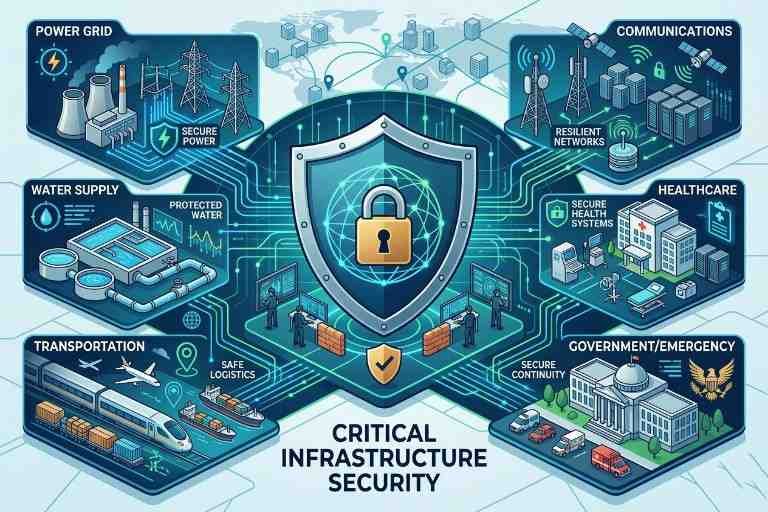
In today’s digital world, critical infrastructure serves as the foundation of modern society. Essential systems such as electricity grids, water treatment plants, transportation networks, and healthcare facilities support daily life and economic stability. As these sectors adopt advanced digital technologies and connected systems, they become more efficient—but also increasingly vulnerable to cyber threats.
In 2026, cyberattacks targeting essential infrastructure are growing in both frequency and sophistication. A successful attack on power systems, hospitals, transportation services, or water supplies can disrupt public services, create financial losses, and even threaten human safety. This rising threat makes Critical Infrastructure Security a top cybersecurity priority worldwide.
Critical infrastructure security focuses on protecting essential services and industrial systems from cyberattacks, operational failures, and unexpected disasters.
What is Critical Infrastructure Security?
Critical infrastructure security refers to the strategies, technologies, and policies designed to protect systems that provide essential public and economic services. It combines cybersecurity, operational technology protection, risk management, and disaster recovery planning to maintain reliable operations.
Key sectors protected under critical infrastructure security include:
- Electricity and power grids
- Water supply and treatment systems
- Transportation and logistics
- Healthcare and emergency services
- Telecommunications
- Manufacturing and industrial facilities
- Banking and financial systems
These systems are interconnected, meaning a disruption in one sector can affect many others. Because of this interdependence, securing infrastructure requires continuous monitoring and strong cybersecurity controls.
Why Critical Infrastructure Security Matters
Digital transformation has improved operational efficiency but also expanded the cyberattack surface. Many critical systems rely on Industrial Control Systems (ICS) and Supervisory Control and Data Acquisition (SCADA) systems that were originally designed for performance rather than cybersecurity.
Cybercriminals and hostile actors often target these environments through:
- Ransomware attacks
- Malware infections
- Insider threats
- Remote access vulnerabilities
- Phishing attacks
- Supply chain compromises
- Denial-of-service attacks
The consequences of these attacks extend far beyond data loss. Infrastructure disruptions can interrupt public services, delay medical treatment, halt transportation, and damage industrial operations.
Strong security measures help ensure public safety, economic continuity, and national resilience.
SCADA System Security
Supervisory Control and Data Acquisition (SCADA) systems are widely used to monitor and control industrial operations. Power generation facilities, water treatment plants, transportation systems, and manufacturing industries depend heavily on SCADA environments.
Because SCADA systems control physical operations, their security is extremely important.
SCADA security strategies include:
Network Segmentation
Separating operational networks from corporate and public networks reduces exposure to cyber threats.
Secure Remote Access
Organizations implement secure VPNs and authentication systems to protect remote control functions.
Continuous Monitoring
Security teams monitor SCADA environments for suspicious activity and unauthorized access attempts.
Software Updates and Patching
Keeping SCADA software updated helps reduce known vulnerabilities.
Modern industries increasingly use AI-powered monitoring systems that can identify unusual operational behavior and alert security teams before serious damage occurs.
Industrial Control System (ICS) Protection
Industrial Control Systems (ICS) manage machinery and automated industrial processes. These systems are commonly used in power plants, factories, oil facilities, and transportation networks.
An attack against ICS systems can cause:
- Equipment damage
- Production shutdowns
- Service interruptions
- Financial losses
- Worker safety risks
Protecting ICS environments requires a layered cybersecurity approach.
Important ICS protection practices include:
Access Control and Authentication
Only authorized personnel should access industrial systems and sensitive configurations.
Vulnerability Assessment
Regular testing helps identify software and hardware weaknesses before attackers exploit them.
Real-Time Threat Detection
Security monitoring tools detect abnormal system activity and suspicious behavior.
Employee Awareness
Human error remains a major cybersecurity challenge. Training employees helps reduce phishing and social engineering risks.
In 2026, industries increasingly integrate IT and Operational Technology (OT) security to improve visibility and strengthen protection across industrial environments.
Backup and Disaster Recovery
Even the strongest cybersecurity systems cannot guarantee complete protection. That is why backup and disaster recovery planning remains essential for critical infrastructure security.
Disaster recovery ensures organizations can restore operations quickly following cyberattacks, hardware failures, or natural disasters.
Effective backup and recovery strategies include:
- Automated backups
- Offsite and cloud storage
- Redundant infrastructure
- Incident response planning
- Business continuity testing
- Recovery time planning
Hospitals, transportation systems, and utility providers depend on rapid recovery because service interruptions directly impact communities and public safety.
Cloud-based recovery systems and automated restoration technologies now play a growing role in reducing downtime and improving operational resilience.
Future of Critical Infrastructure Security
As smart cities, automation, and connected industrial systems continue expanding, infrastructure protection becomes increasingly complex.
Emerging security trends in 2026 include:
- AI-powered threat detection
- Zero Trust Architecture
- Predictive cybersecurity analytics
- Automated incident response
- OT and IT security integration
- Quantum-resistant encryption research
Governments and industries worldwide are strengthening regulations and investing in infrastructure cybersecurity to address evolving threats.