


 By
By Application Security in 2026: Building Secure Software in an Era of Evolving Cyber Threats
As organizations continue their digital transformation journeys, software applications have become the backbone of business operations, customer engagement, and online services. From web applications and mobile apps to cloud-native platforms and enterprise systems, applications handle enormous volumes of sensitive data every day. However, this growing dependence on software has also made applications a prime target for cybercriminals.
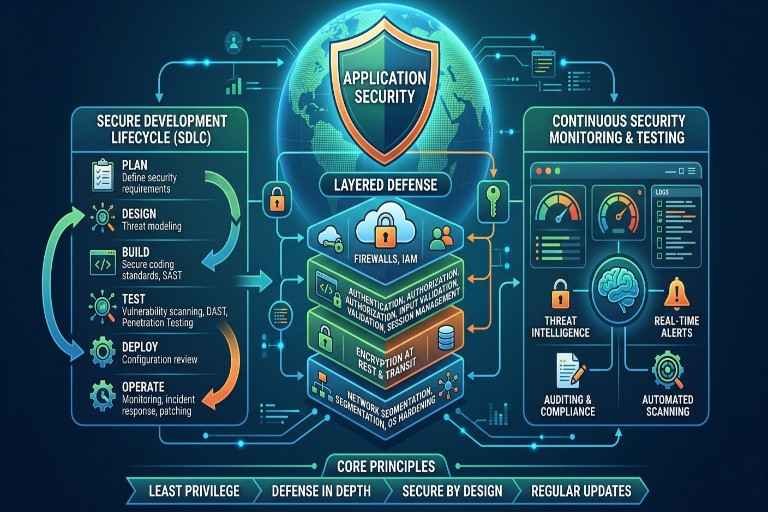
Application Security (AppSec) focuses on protecting software applications from vulnerabilities, cyberattacks, and unauthorized access throughout the development lifecycle. In 2026, organizations are increasingly adopting proactive security strategies to ensure applications remain resilient against modern threats while maintaining performance and user trust.
Why Application Security Matters
Cyberattacks targeting applications continue to rise because applications often serve as direct entry points to valuable business data and systems. Vulnerabilities such as insecure authentication, broken access controls, injection flaws, and misconfigured APIs can provide attackers with opportunities to compromise applications.
The consequences of an application security breach can include:
- Exposure of sensitive customer information.
- Financial losses due to fraud or downtime.
- Regulatory penalties and compliance violations.
- Damage to brand reputation.
- Loss of customer trust.
As businesses release software more rapidly than ever before, security must be integrated into every stage of the software development process rather than treated as an afterthought.
Secure Coding Practices: Security Starts with Development
One of the most effective ways to improve application security is by adopting secure coding practices. Vulnerabilities introduced during development are often exploited by attackers after deployment.
Secure coding involves designing and writing software with security considerations from the beginning. Developers should follow established security standards and coding guidelines to minimize risks.
Key secure coding practices include:
Using secure APIs and trusted libraries.
Validating and sanitizing user input.
Implementing strong authentication and authorization mechanisms.
Protecting sensitive data through encryption.
Avoiding hardcoded credentials and secrets.
Applying proper error handling and logging.
Organizations are increasingly providing developers with cybersecurity training to ensure security awareness becomes a core part of the development culture.
Penetration Testing: Thinking Like an Attacker
Even well-designed applications may contain hidden vulnerabilities. Penetration testing helps organizations identify weaknesses before cybercriminals can exploit them.
Penetration testing, often called ethical hacking, involves security professionals simulating real-world attacks against applications to evaluate their security posture.
Benefits of penetration testing include:
Supporting compliance requirements.
Discovering security flaws before deployment.
Validating existing security controls.
Identifying misconfigurations.
Improving incident response readiness.
Regular penetration testing provides organizations with valuable insights into how attackers might target their applications and helps prioritize remediation efforts.
Code Scanning and Vulnerability Management
Modern development environments rely heavily on automation to identify security issues quickly and efficiently. Automated code scanning tools have become essential components of secure software development.
There are two primary approaches:
Static Application Security Testing (SAST)
SAST tools analyze source code before applications are executed. They help identify coding errors, insecure functions, and potential vulnerabilities early in the development lifecycle.
Dynamic Application Security Testing (DAST)
DAST tools assess running applications by simulating attacks and evaluating responses. This approach helps identify runtime vulnerabilities that may not be visible through code analysis alone.
Organizations increasingly combine SAST, DAST, and Software Composition Analysis (SCA) tools to gain comprehensive visibility into application security risks.
However, finding vulnerabilities is only the first step. Effective vulnerability management requires prioritizing risks, applying fixes promptly, and continuously monitoring applications for new threats.
The Rise of DevSecOps
One of the most significant trends in application security is the adoption of DevSecOps. This approach integrates security directly into the software development and deployment process.
Traditionally, security reviews occurred near the end of development. DevSecOps shifts security left, embedding security testing and validation throughout the entire software lifecycle.
Benefits of DevSecOps include:
- Faster vulnerability detection.
- Reduced remediation costs.
- Improved collaboration between development and security teams.
- Faster and more secure software releases.
By automating security controls within development pipelines, organizations can maintain both speed and security.
Emerging Application Security Trends in 2026
As technology evolves, application security continues to adapt to new challenges.
AI-Powered Security Testing
Artificial intelligence is helping organizations identify vulnerabilities, prioritize risks, and automate remediation efforts more efficiently.
API Security
With applications increasingly relying on APIs, securing API endpoints has become a major focus area for developers and security teams.
Zero Trust Application Access
Organizations are implementing Zero Trust principles to continuously verify users, devices, and services before granting access to application resources.
Supply Chain Security
Software supply chain attacks have increased significantly, prompting organizations to closely monitor third-party libraries, frameworks, and dependencies.