


 By
By Database Security in 2026: Protecting Critical Data from AI-Powered Cyber Threats
Data has become one of the most valuable assets in the modern digital economy. Businesses store customer records, financial transactions, healthcare information, employee details, intellectual property, and operational data inside databases. As organizations increasingly adopt cloud computing, artificial intelligence, and data-driven applications, databases are becoming larger, more connected, and more attractive targets for cybercriminals. In 2026, database security is no longer simply about protecting a database server—it is about securing data, identities, applications, APIs, and access across the entire data environment.
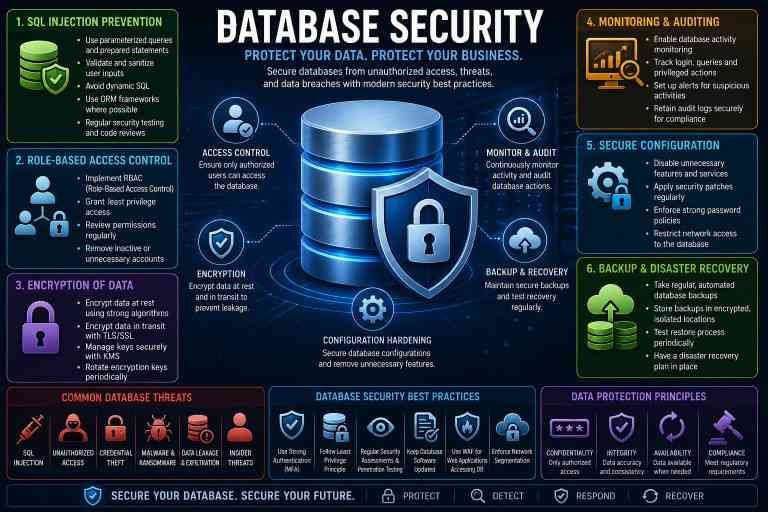
Database Security refers to the technologies, policies, and processes used to protect databases from unauthorized access, theft, corruption, manipulation, and destruction. A modern database security strategy combines secure application development, strong identity controls, encryption, continuous monitoring, vulnerability management, and reliable backup systems.
Why Database Security Matters
A compromised database can have serious consequences for an organization. Attackers may steal sensitive customer information, modify financial records, deploy ransomware, or use stolen credentials to access other systems.
Modern database environments face threats including SQL injection, credential theft, insider attacks, ransomware, excessive privileges, exposed cloud databases, insecure APIs, and vulnerable third-party software.
The increasing use of AI is also changing the threat landscape. Attackers can use AI to automate reconnaissance, generate malicious code, identify weaknesses, and accelerate phishing or credential-theft campaigns. At the same time, security teams are using AI to detect abnormal database activity and prioritize vulnerabilities.
SQL Injection Prevention
SQL Injection remains one of the most important application-level threats to databases. It occurs when attackers manipulate application inputs to execute unauthorized SQL commands.
A successful SQL injection attack can allow an attacker to read, modify, or delete database information.
Developers can reduce SQL injection risks by following secure coding practices such as:
- Using parameterized queries and prepared statements.
- Validating and sanitizing user input.
- Avoiding unnecessary dynamic SQL.
- Applying secure database permissions.
- Performing regular security testing.
- Using Web Application Firewalls where appropriate.
- Keeping application frameworks and database software updated.
Security should be integrated into the Software Development Lifecycle rather than being treated as a final testing step.
Role-Based Access and Least Privilege
Not every employee, application, or service needs access to every database record. Role-Based Access Control (RBAC) allows organizations to assign permissions according to job responsibilities.
For example, a customer-support employee may only need read access to specific customer information, while a database administrator may require broader privileges for maintenance.
Organizations should follow the Principle of Least Privilege, giving users and applications only the permissions they actually need.
Important controls include:
- Multi-Factor Authentication (MFA)
- Privileged Access Management (PAM)
- Regular permission reviews
- Automatic removal of inactive accounts
- Strong service-account controls
- Monitoring privileged activities
This approach limits the damage that can occur if an account or application credential is compromised.
Encryption of Data at Rest
Encryption protects databases even when unauthorized users gain access to underlying storage.
Data at rest includes information stored in databases, snapshots, backup files, and storage systems. Encrypting this information makes it significantly harder for attackers to use stolen database files.
Organizations should also protect data in transit using secure protocols such as TLS when information moves between applications, users, APIs, and database servers.
Encryption should be supported by strong key-management practices, including restricted key access, regular rotation, secure storage, and appropriate separation of duties.
Cloud Database Security
Cloud databases provide scalability and flexibility, but misconfiguration can expose sensitive information to the public internet.
Organizations should regularly review:
- Database access policies
- Network security groups and firewall rules
- Public exposure settings
- Encryption configurations
- IAM permissions
- Backup policies
- API access
- Audit logs
Cloud Security Posture Management (CSPM) and Cloud-Native Application Protection Platforms (CNAPP) can help organizations continuously identify configuration problems and security risks across cloud environments.
AI-Powered Database Monitoring
Traditional database security tools may struggle to analyze the enormous volume of events generated by modern applications. AI and machine learning can help security teams identify unusual database behavior in real time.
AI-powered monitoring can detect patterns such as:
- Unusual login locations
- Large unexpected data exports
- Abnormal SQL queries
- Sudden privilege changes
- Repeated failed authentication attempts
- Unusual administrator activity
By establishing a baseline of normal database behavior, machine-learning systems can identify anomalies and alert security teams before suspicious activity becomes a major breach.
However, AI-based security tools should operate with appropriate human oversight, particularly when automated actions could affect critical production systems.
Backup, Recovery, and Ransomware Protection
Database security must also prepare for situations where prevention fails. Ransomware can encrypt databases and backups, potentially bringing business operations to a standstill.
Organizations should maintain multiple protected backup copies and regularly test restoration procedures. Offline, isolated, or immutable backups can make it significantly harder for attackers to destroy recovery options.
A strong recovery strategy should define Recovery Time Objectives (RTO), Recovery Point Objectives (RPO), restoration priorities, and emergency response procedures.
The Future of Database Security
Database security is moving toward a more proactive and identity-centric model. Organizations are increasingly combining Zero Trust principles, AI-powered monitoring, automated vulnerability management, encryption, and continuous access reviews.
As databases become integrated with AI applications and autonomous services, securing non-human identities such as service accounts, API credentials, and AI agents will also become increasingly important.