


 By
By Critical Infrastructure Security in 2026: Protecting Essential Services from Evolving Cyber Threats
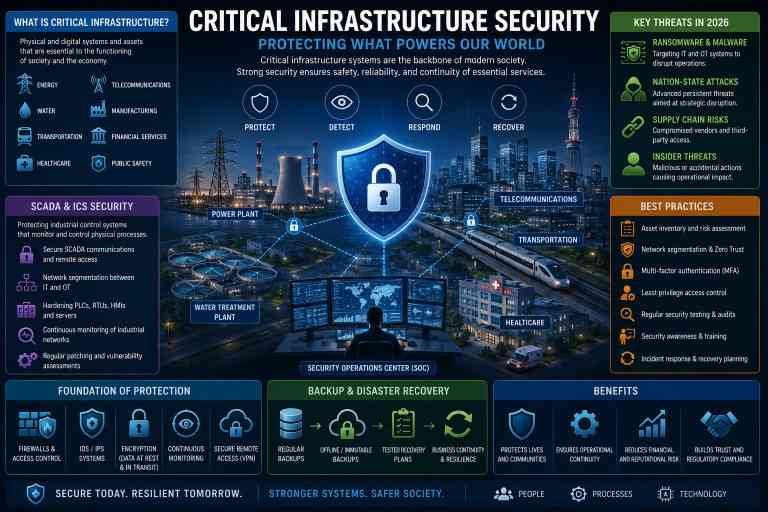
Critical infrastructure is the foundation of modern society. Electricity grids, water treatment facilities, transportation networks, hospitals, telecommunications systems, energy facilities, and other essential services support millions of people every day. As these systems become increasingly connected and automated, cybersecurity has become just as important as physical protection. In 2026, Critical Infrastructure Security is becoming a major priority as cyberattacks increasingly target the technology that controls real-world operations.
Critical Infrastructure Security refers to the technologies, policies, processes, and security controls used to protect essential services from cyberattacks, physical threats, operational failures, and other disruptions. Modern protection focuses heavily on Operational Technology (OT), Industrial Control Systems (ICS), SCADA environments, network segmentation, continuous monitoring, and disaster recovery.
Why Critical Infrastructure Security Matters
A cyberattack against a normal business may cause financial losses or temporary downtime. An attack against critical infrastructure can have much broader consequences, potentially affecting public safety, healthcare, transportation, energy supplies, and entire communities.
The 2026 cybersecurity landscape is being shaped by artificial intelligence, geopolitical tensions, ransomware, and supply-chain vulnerabilities. The World Economic Forum reports that 64% of organizations are factoring geopolitically motivated cyberattacks into their risk strategies, including attacks designed to disrupt critical infrastructure.
At the same time, attackers are increasingly targeting industrial environments and moving closer to systems that control physical processes. Dragos reported in its 2026 OT cybersecurity review that ransomware groups with reach into OT environments increased significantly and that threat actors are increasingly mapping industrial control processes.
Protecting SCADA Systems
Supervisory Control and Data Acquisition (SCADA) systems are widely used to monitor and control industrial processes. They play an important role in sectors such as electricity, water management, manufacturing, energy, and transportation.
Because SCADA systems can directly influence physical operations, compromising them can have serious consequences. Organizations should protect SCADA environments through:
- Strong authentication and Multi-Factor Authentication (MFA)
- Network segmentation and controlled remote access
- Continuous monitoring of SCADA traffic
- Secure configuration management
- Regular vulnerability assessments
- Controlled and tested software updates
- Strict access permissions
SCADA systems should also be isolated from unnecessary internet exposure and protected through carefully designed IT/OT network boundaries.
Industrial Control System and OT Security
Industrial Control Systems include Programmable Logic Controllers (PLCs), Distributed Control Systems (DCS), Human-Machine Interfaces (HMIs), sensors, and other technologies used to automate physical processes.
The increasing convergence of IT and OT creates both operational benefits and cybersecurity challenges. Modern industrial environments require connectivity for analytics, remote management, cloud services, and automation, but this connectivity can also create additional attack paths.
The World Economic Forum notes that IT and OT convergence is increasing across manufacturing, energy, transportation, and critical infrastructure, creating a need for stronger segmentation and improved OT governance.
Organizations should maintain accurate inventories of OT assets, restrict unnecessary connections, monitor industrial networks, implement least-privilege access, and ensure security teams understand the operational impact of security changes.
AI-Powered Threat Detection
Artificial Intelligence is becoming an important part of critical infrastructure defense. AI-powered monitoring systems can analyze large volumes of network and operational data to identify abnormal behavior much faster than traditional manual monitoring.
AI can help security teams detect:
- Unusual network activity
- Suspicious authentication attempts
- Abnormal industrial device behavior
- Malware and ransomware indicators
- Unauthorized configuration changes
- Potential attacks against operational systems
However, AI also introduces new risks. The World Economic Forum identifies AI as one of the biggest forces shaping cybersecurity in 2026, with 87% of respondents reporting that AI-related vulnerabilities increased during 2025.
Therefore, organizations should combine AI-powered monitoring with human oversight, strong governance, and well-tested incident response procedures.
Ransomware and Supply Chain Protection
Ransomware remains a significant concern for critical infrastructure because downtime can directly affect essential services. Attackers may target IT networks first and attempt to move toward OT environments or use compromised third-party suppliers as an entry point.
Organizations should implement:
- Network segmentation
- Endpoint and server protection
- Least-privilege access
- MFA for remote connections
- Continuous vulnerability management
- Vendor security assessments
- Offline and immutable backups
- Regular incident-response exercises
Third-party suppliers should also be included in security assessments because a weakness in a vendor’s environment can create risks for connected infrastructure.
Backup and Disaster Recovery
Cybersecurity cannot guarantee that every attack will be prevented. Critical infrastructure operators therefore need strong resilience and recovery capabilities.
A comprehensive disaster recovery strategy should include:
- Regular backups of critical configurations and data
- Offline or isolated backup copies
- Defined Recovery Time Objectives (RTO)
- Defined Recovery Point Objectives (RPO)
- Emergency communication procedures
- Alternative operational procedures
- Regular recovery testing
Backup systems should be protected from ransomware so attackers cannot easily encrypt or delete recovery copies.
Building Cyber Resilience
Modern critical infrastructure security is moving beyond simple prevention toward cyber resilience. Organizations need the ability to withstand an attack, continue essential operations, detect incidents quickly, and recover safely.
A resilient strategy combines cybersecurity with physical security, business continuity, emergency response, threat intelligence, employee training, and collaboration between government agencies and private organizations.
Standards and frameworks such as the NIST Cybersecurity Framework and IEC 62443 can help organizations structure security programs for IT and industrial environments.