

 By
By Andhra Pradesh has taken a major step towards improving water availability in some of its drought-prone regions with the commissioning of the first phase of the Poola Subbaiah Veligonda Project. The project, which has been in the making for several years, is designed to bring Krishna River floodwaters from the Srisailam Reservoir to the newly developed Nallamala Sagar reservoir.
The first phase was inaugurated on August 31, 2026, marking an important milestone for the project and for thousands of people who have been waiting for a more reliable water supply.
A Water Project Built Beneath the Nallamala Hills
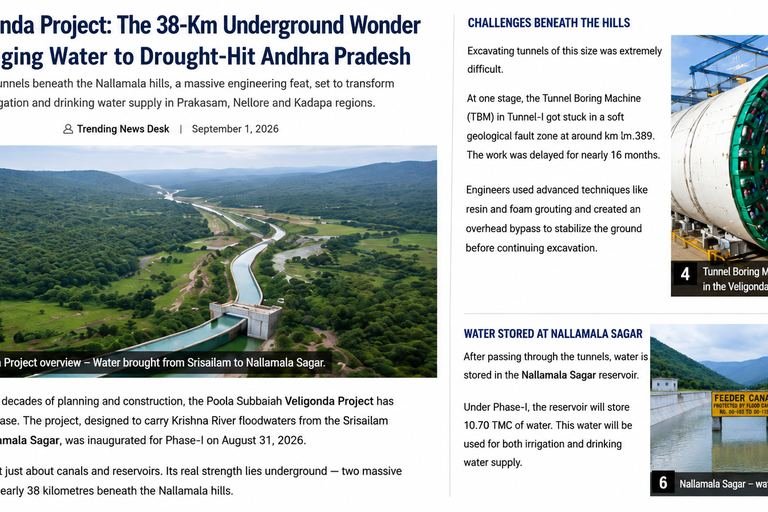
The most striking feature of the Veligonda Project is its twin underground tunnel system. Instead of taking the water around the Nallamala hills, engineers created a route beneath them.
The two tunnels are nearly 19 kilometres each. Tunnel-I measures about 18.82 kilometres, while Tunnel-II stretches for around 18.79 kilometres. Together, they form an underground water passage of nearly 38 kilometres.
The tunnels connect the intake area near Kollam Vagu, on the foreshore of the Srisailam Reservoir, with the water-storage system at Nallamala Sagar.
This underground route is one of the reasons the Veligonda Project stands out among major irrigation projects in Andhra Pradesh.
Gravity Does the Heavy Lifting
Another important aspect of the project is that the water is designed to move mainly through gravity, rather than depending on continuous pumping.
Water is diverted from the Srisailam Reservoir system and enters the tunnel network before moving towards Nallamala Sagar. The difference in elevation allows the water to travel naturally through the system.
This has a major long-term advantage. A gravity-based water-transfer system can reduce the recurring electricity requirements that would otherwise be needed for large-scale pumping.
Construction Was Far From Easy
Building almost 38 kilometres of tunnels beneath a mountain range was not a simple engineering exercise.
Workers had to deal with changing rock conditions, underground water and difficult geological formations. At one stage, excavation of Tunnel-I faced a particularly serious setback when the Tunnel Boring Machine encountered a weak fault zone.
The machine became stuck, bringing excavation to a halt for around 16 months. Engineers eventually used specialised tunnelling techniques to stabilise the surrounding area and resume the work.
The project also had to be executed in a sensitive forest environment. The tunnel intake area lies within the Nagarjunasagar-Srisailam Tiger Reserve, creating additional logistical and environmental challenges for construction teams.
Water Storage at Nallamala Sagar
Once the water passes through the underground tunnels, it enters a feeder canal before reaching the Nallamala Sagar reservoir.
Under Phase-I, the reservoir is expected to store 10.70 TMC of water. The first phase is planned to provide irrigation facilities to around 1.19 lakh acres and drinking water benefits to nearly four lakh people.
The larger project has been designed with a much greater capacity. Once the complete system is developed, the reservoir is expected to play a wider role in supplying water for agriculture and drinking purposes across several drought-prone areas.
Relief for Water-Stressed Regions
The project is particularly important for areas where farmers have traditionally depended heavily on uncertain rainfall and groundwater.
The Veligonda system is intended to benefit parts of Prakasam, Markapuram, Nellore and Kadapa regions. The availability of a more dependable surface-water source could help farmers reduce their dependence on groundwater and provide greater stability for agricultural activity.
Drinking water is another major component. The project is expected to improve access to safer water for communities in the project’s command areas.
A Long Journey Comes to a Milestone
The Veligonda Project has a history stretching back decades. The idea was developed to address the recurring water shortage in the upland areas of Andhra Pradesh, and the project went through multiple stages of planning, construction and financial commitments.
The recent completion of Phase-I represents a significant point in that long journey.
The Andhra Pradesh government has now indicated that work on the second phase will continue, with the broader objective of extending the benefits of the project to more areas.
More Than an Engineering Project
For engineers, Veligonda represents a major underground tunnelling challenge. For farmers, however, its importance is much more straightforward: reliable water can mean more secure cultivation and fewer years of depending entirely on rainfall.
The nearly 38-kilometre tunnel network, the gravity-based water transfer system and the Nallamala Sagar reservoir together form a large water-conveyance system designed to move Krishna floodwaters into drought-prone areas.
The real success of the Veligonda Project will ultimately be measured not by the size of its tunnels, but by how effectively water reaches farms, villages and households.
For Andhra Pradesh’s water-stressed regions, the completion of Phase-I therefore represents more than the opening of another irrigation project. It marks the beginning of a new attempt to turn seasonal river water into a more dependable resource for people and agriculture.