

 By
By AI PCs Are Becoming the Next Big Trend in Computers
The computer industry is moving into a new phase in 2026, and AI PCs are at the center of that transformation. Instead of depending entirely on cloud-based artificial intelligence, newer computers are increasingly designed to perform AI workloads directly on the device. This shift is changing how laptops and desktops handle productivity, communication, creativity and everyday computing.
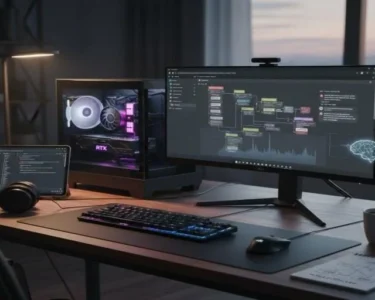
One of the latest developments is the growing availability of software capable of running AI tasks locally. For example, Perplexity has introduced a Windows version of its local AI computer application that can perform multistep tasks on compatible NVIDIA-powered PCs without requiring every operation to be processed in the cloud. The software currently requires an NVIDIA RTX or RTX PRO GPU with at least 24GB of VRAM.
Why Local AI Matters
Traditional AI applications often send information to remote data centers for processing. Local AI changes this model by using processors inside the computer to handle certain tasks.
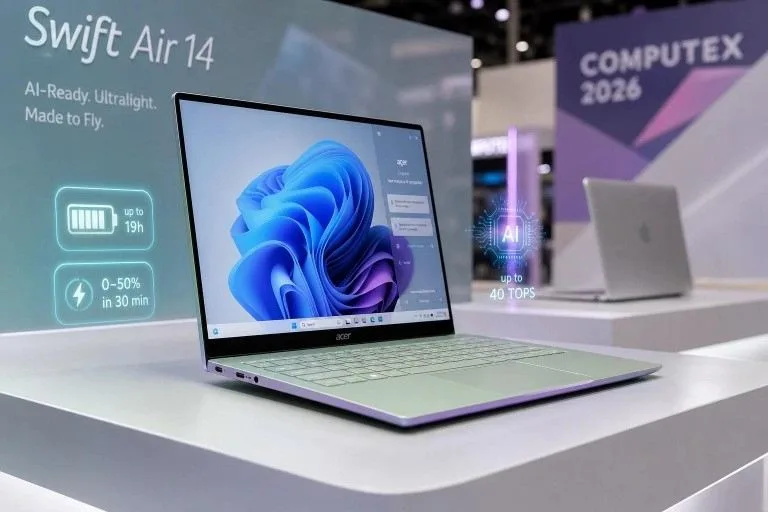
Modern AI PCs combine a CPU, GPU and NPU (Neural Processing Unit) to distribute workloads efficiently. The NPU is specifically designed for AI operations and can handle tasks such as background effects during video calls, image processing, voice recognition and other AI features while consuming relatively little power.
This approach can also reduce dependence on an internet connection for supported features. For users, that can mean faster responses and potentially greater privacy because some processing can happen directly on the computer.
New Chips Are Driving AI PC Development
Processor manufacturers are increasingly designing chips around AI capabilities rather than treating AI as an additional feature. Current PC platforms from companies such as Intel, AMD, Qualcomm and NVIDIA combine conventional computing with dedicated AI acceleration.
ASUS, for example, recently announced its Ascent QN10 mini PC powered by Qualcomm’s Snapdragon X2 Elite platform. ASUS says the system includes an 80 TOPS NPU, illustrating how dedicated AI processing is becoming a significant specification for compact computers as well as laptops.
The importance of these processors extends beyond simply running chatbots. Developers are exploring AI-assisted coding, document analysis, content creation, image generation, translation and computer-control features that can operate closer to the user.
AI Agents Could Change How We Use Computers
Another important trend is the development of AI agents. Instead of requiring users to perform every step manually, an AI agent can potentially carry out a sequence of tasks.
For example, a user could ask a computer to organize files, summarize documents, prepare information or interact with supported applications. Local AI could make these experiences more responsive while reducing the amount of data that needs to travel to cloud servers.
Microsoft is also preparing another major Windows and Surface event focused on local AI. A Windows and Surface event is scheduled for October 7, with Microsoft executives and NVIDIA CEO Jensen Huang expected to participate.
Cooling Is Becoming Important for AI Laptops
As computers perform more AI calculations locally, managing heat becomes increasingly important. Higher performance traditionally means more power consumption and heat, which can require larger fans and cooling systems.
A recent Lenovo concept called AeroBlade demonstrates another approach. The concept laptop uses AirJet solid-state cooling technology instead of conventional cooling hardware. According to Live Science, the system uses four AirJet Mini chips and is designed to remove up to 30 watts of heat while operating at around 21 decibels.
Although AeroBlade is currently a concept rather than a mainstream product, it demonstrates how thermal engineering is becoming an important part of designing thin AI-capable computers.
What to Expect From Computers Next
The computer market is increasingly moving toward devices that combine AI performance, battery efficiency, privacy, connectivity and traditional computing power.
For consumers, the most important question will not simply be whether a laptop has an “AI” label. Buyers will need to consider what AI features are actually useful, how much processing happens locally, the performance of the NPU, RAM capacity, battery life, software compatibility and upgrade options.
The growing availability of local AI applications suggests that computers are gradually becoming more than tools for running traditional software. They are evolving into intelligent computing platforms capable of assisting users directly.
As hardware manufacturers continue improving NPUs, GPUs, processors and cooling technologies, 2026 could become an important turning point for the AI PC market. The next generation of computers is likely to focus not just on being faster, but on becoming more capable of understanding, processing and assisting with everyday tasks directly on the device.