


 By
By Cloud Security in 2026: Essential Strategies to Protect Data, Applications, and Cloud Infrastructure
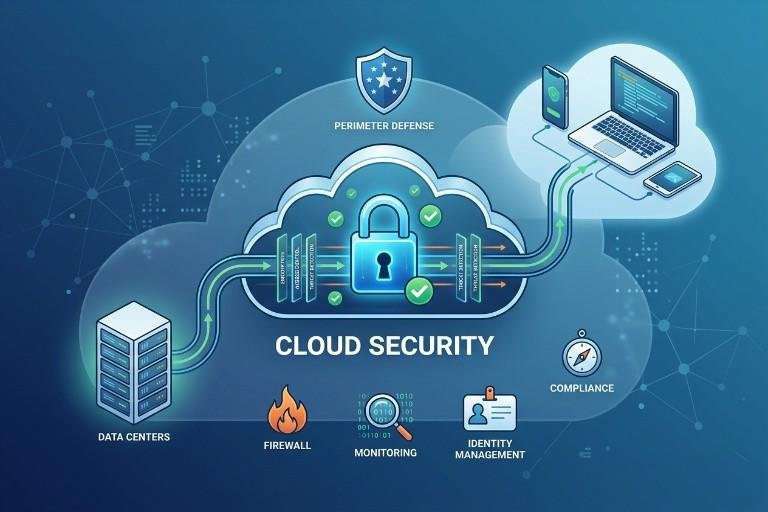
As organizations continue their digital transformation journey, cloud computing remains the foundation of modern business operations. From startups to global enterprises, cloud platforms provide flexibility, scalability, and cost efficiency. However, the increasing adoption of cloud services has also attracted cybercriminals seeking to exploit vulnerabilities, making cloud security one of the most critical cybersecurity priorities in 2026.
Cloud security refers to the technologies, policies, controls, and practices used to protect data, applications, and infrastructure hosted on cloud platforms. With businesses relying heavily on cloud providers such as AWS, Microsoft Azure, and Google Cloud, securing cloud environments is no longer optional—it is a business necessity.
Why Cloud Security Matters More Than Ever
The cloud stores vast amounts of sensitive information, including customer records, financial data, intellectual property, and business-critical applications. A single security breach can result in data loss, financial penalties, reputational damage, and operational disruptions.
Recent cybersecurity trends show that attackers are increasingly targeting misconfigured cloud environments, exposed APIs, and compromised user credentials. As cloud ecosystems become more complex, organizations must adopt proactive security strategies to stay ahead of evolving threats.
Cloud Encryption: Protecting Data Everywhere
Encryption remains one of the most effective cloud security measures. It converts sensitive information into unreadable code, ensuring that even if attackers gain access to the data, they cannot interpret it without the proper decryption keys.
Organizations should implement:
- Encryption for data at rest stored in cloud databases and storage services.
- Encryption for data in transit moving between users, applications, and cloud servers.
- Strong key management practices to prevent unauthorized access to encryption keys.
Modern cloud providers offer advanced encryption tools, but organizations must ensure proper configuration and regular audits to maintain security.
Identity and Access Management (IAM): Controlling Who Has Access
Identity and Access Management (IAM) has become the backbone of cloud security. Many cloud breaches occur because users are granted excessive permissions or because compromised credentials are used to access sensitive resources.
A strong IAM strategy includes:
- Multi-Factor Authentication (MFA) for all user accounts.
- Role-Based Access Control (RBAC) to ensure users receive only the permissions necessary for their jobs.
- Regular access reviews to remove unnecessary privileges.
- Zero Trust principles that continuously verify users and devices before granting access.
By limiting access rights and verifying identities, organizations can significantly reduce the risk of unauthorized access.
Continuous Monitoring and Threat Detection
Traditional security approaches are no longer sufficient in dynamic cloud environments. Continuous monitoring has become essential for detecting suspicious activities and responding to threats in real time.
Cloud monitoring solutions help organizations:
- Identify unusual login attempts.
- Detect unauthorized configuration changes.
- Monitor network traffic for malicious behavior.
- Receive automated alerts for security incidents.
Artificial intelligence and machine learning are increasingly being integrated into cloud security platforms, enabling faster threat detection and more accurate risk assessments. This proactive approach helps security teams respond to incidents before they escalate into major breaches.
Securing Cloud Infrastructure
Cloud infrastructure security involves protecting servers, containers, virtual machines, databases, and networking components from cyber threats.
Best practices include:
- Regularly updating and patching cloud resources.
- Conducting vulnerability assessments and penetration testing.
- Implementing network segmentation to isolate critical workloads.
- Using security groups and firewalls to restrict unnecessary access.
Organizations should also adopt Infrastructure as Code (IaC) security practices to identify vulnerabilities during the development process rather than after deployment.
The Rise of Zero Trust Security
One of the most significant cloud security trends in 2026 is the widespread adoption of Zero Trust Architecture. The principle is simple: never trust, always verify.
Instead of assuming users inside the network are trustworthy, Zero Trust continuously validates every request based on identity, device health, location, and behavior. This approach minimizes the attack surface and prevents lateral movement if an attacker gains access to a system.