


 By
By Database Security in 2026: Protecting Critical Business Data from Modern Cyber Threats
In today’s digital economy, data has become one of the most valuable assets for businesses. Customer information, financial records, healthcare data, intellectual property, and operational insights are all stored in databases that power websites, enterprise applications, and cloud services. As organizations continue their digital transformation in 2026, databases have become prime targets for cybercriminals seeking to steal, manipulate, or destroy sensitive information. This makes database security a critical component of every organization’s cybersecurity strategy.
Database Security refers to the technologies, policies, and best practices used to protect databases from unauthorized access, data breaches, theft, corruption, and cyberattacks. A strong database security framework safeguards the confidentiality, integrity, and availability of data while ensuring compliance with industry regulations and maintaining customer trust.
Why Database Security Matters
Organizations depend on databases to support daily operations and business decision-making. Whether hosted on-premises or in the cloud, databases contain sensitive information that, if compromised, can result in financial losses, legal penalties, operational disruptions, and reputational damage.
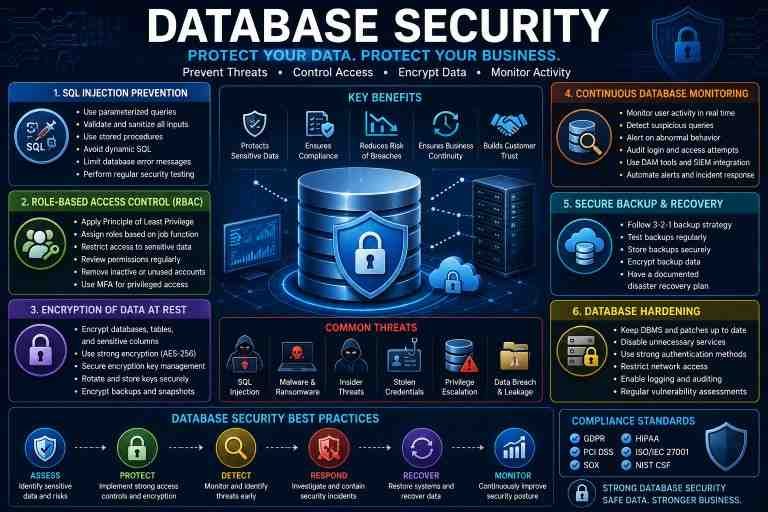
Modern cyber threats include SQL injection attacks, stolen credentials, insider threats, ransomware, privilege escalation, and database misconfigurations. As businesses increasingly adopt cloud-native applications and remote work environments, securing databases requires continuous monitoring, robust access controls, and proactive threat detection.
Investing in database security not only protects valuable information but also strengthens business resilience and customer confidence.
Preventing SQL Injection Attacks
SQL Injection (SQLi) remains one of the most common attacks targeting web applications and databases. It occurs when attackers exploit poorly validated user input to execute unauthorized SQL commands, allowing them to read, modify, or delete sensitive data.
Organizations can significantly reduce the risk of SQL injection by following secure development practices:
- Use parameterized queries and prepared statements.
- Validate and sanitize all user inputs.
- Avoid dynamic SQL whenever possible.
- Implement stored procedures where appropriate.
- Limit database account privileges.
- Hide detailed database error messages from users.
- Perform regular penetration testing and code reviews.
Following secure coding standards, such as the OWASP Top 10 recommendations, helps developers identify and eliminate vulnerabilities before applications are deployed.
Role-Based Access Control (RBAC)
Not every employee requires full access to organizational databases. Role-Based Access Control (RBAC) assigns permissions based on a user’s responsibilities, ensuring that individuals can access only the information necessary for their job.
For example, customer support teams may require read-only access, while database administrators need broader privileges for maintenance and configuration tasks.
Best practices for implementing RBAC include:
- Applying the Principle of Least Privilege (PoLP).
- Enabling Multi-Factor Authentication (MFA).
- Reviewing user permissions regularly.
- Removing inactive accounts promptly.
- Monitoring privileged account activities.
Effective access control minimizes the risk of insider threats and limits the damage caused by compromised user credentials.
Encrypting Data at Rest
Encryption is one of the most powerful methods for protecting stored database information. Data at rest refers to information stored in databases, storage volumes, and backup files. Even if attackers gain access to storage systems, encrypted data remains unreadable without the appropriate encryption keys.
Organizations should encrypt:
- Production databases
- Backup files
- Cloud database storage
- Database snapshots
- Archive storage
Strong encryption standards such as AES-256 provide robust protection, while secure key management practices—including regular key rotation and restricted access—ensure encryption remains effective.
Continuous Database Monitoring
Traditional security measures are no longer enough to defend against sophisticated cyber threats. Continuous monitoring provides real-time visibility into database activity, enabling organizations to identify suspicious behavior before it escalates into a security incident.
Database Activity Monitoring (DAM) solutions can detect:
- Unauthorized login attempts
- Privilege escalation
- Large or unusual data exports
- Failed authentication attempts
- Suspicious SQL queries
- Insider misuse
Many modern platforms use Artificial Intelligence (AI) and machine learning to analyze database behavior, identify anomalies, and alert security teams to potential threats with greater speed and accuracy.
Backup, Recovery, and Compliance
Even the most secure databases require reliable backup and disaster recovery plans. Following the 3-2-1 backup strategy—three copies of data, stored on two different media, with one copy kept offline or offsite—helps organizations recover quickly from ransomware attacks, hardware failures, or accidental data loss.
Database security also supports compliance with regulations such as GDPR, HIPAA, PCI DSS, and ISO/IEC 27001. Regular security audits, vulnerability assessments, and backup testing ensure organizations meet compliance requirements while maintaining operational continuity.