


 By
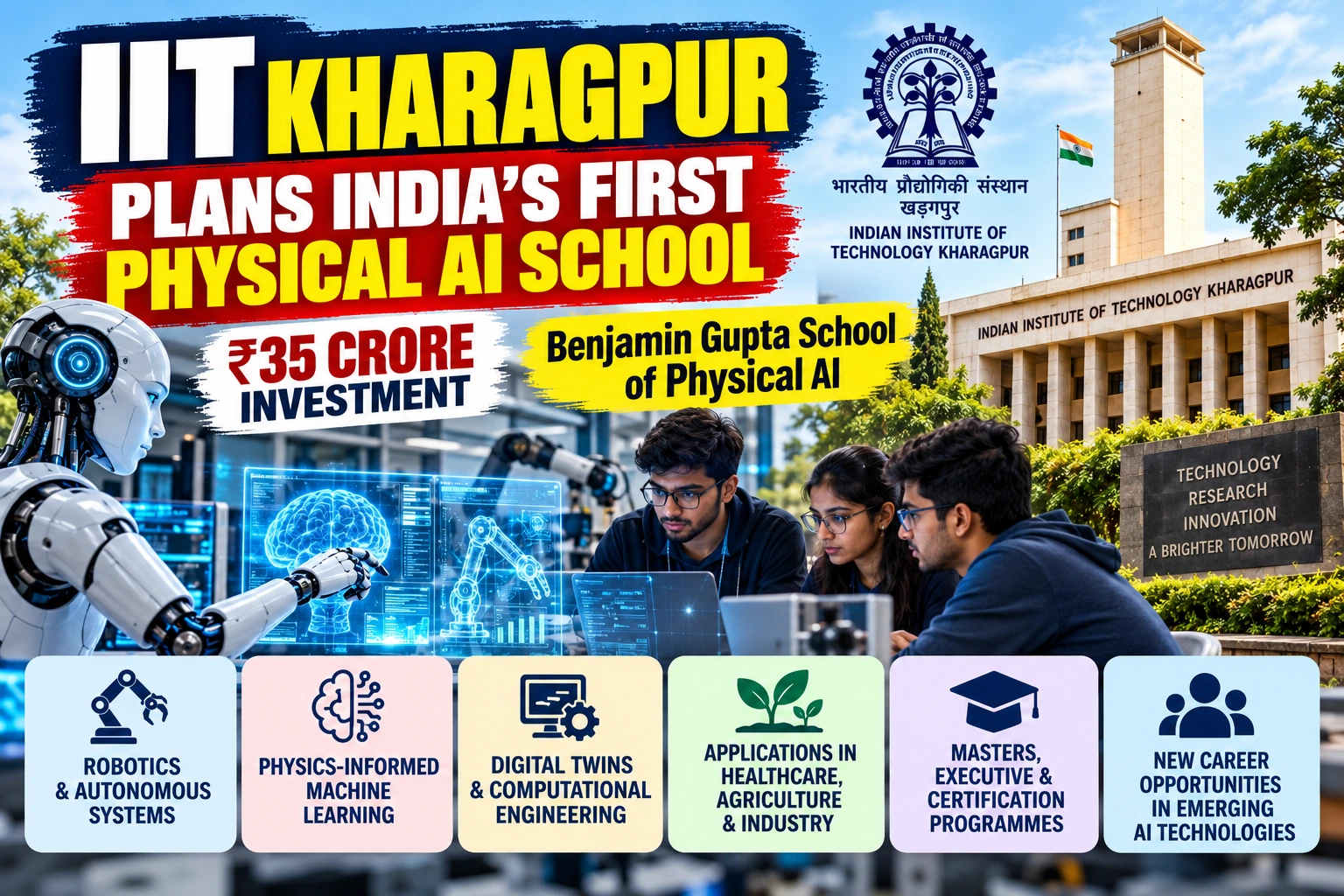
The Indian Institute of Technology (IIT) Kharagpur has announced plans to establish India’s first dedicated academic school focused on Physical Artificial Intelligence (Physical AI). Named the Benjamin Gupta School of Physical AI, the proposed institution will receive an investment of ₹35 crore and focus on artificial intelligence research, interdisciplinary education and real-world technological innovation.
The initiative represents an important development in India’s AI education sector. Unlike conventional artificial intelligence, which primarily processes data and performs digital tasks, Physical AI focuses on intelligent systems that can understand, interact with and respond to the physical world.
The school is expected to bring together artificial intelligence, physics, engineering, robotics, healthcare and other scientific disciplines. Academic programmes are expected to begin in the upcoming academic session, subject to the necessary approvals.
What Is the Benjamin Gupta School of Physical AI?
IIT Kharagpur plans to establish the new school through a memorandum of understanding involving the institute, its distinguished alumnus and philanthropist Vinod Gupta, and the IITKGP Foundation USA.
The school is named in memory of Benjamin Gupta, the late son of Vinod Gupta. It will house the institute’s Department of Artificial Intelligence and support interdisciplinary academic and research activities.
The initiative aims to advance AI technologies that go beyond digital applications and can operate reliably in real-world environments.
For example, conventional AI can analyse an image or answer a question, while Physical AI can help a robot recognise objects, navigate a factory, avoid obstacles and perform tasks safely. Similarly, AI-powered scientific systems can combine sensor information, physical laws and computational models to improve research and engineering processes.
₹35 Crore Investment: Funding Details
The proposed school will be supported by contributions from alumni and the institute.
The funding structure is as follows:
- Vinod Gupta family: ₹12.5 crore
- Anonymous alumnus: ₹10 crore
- IIT Kharagpur: ₹12.5 crore
The total investment amounts to ₹35 crore.
The funding will support dedicated infrastructure for the Department of Artificial Intelligence and associated interdisciplinary research and academic activities.
The project also highlights the important role of alumni contributions in strengthening higher education institutions and supporting advanced scientific research in India.
What Makes Physical AI Different from Traditional AI?
Artificial intelligence is already widely used in chatbots, image recognition, recommendation systems, language translation and data analysis.
Physical AI extends these capabilities to systems that must interact with real-world environments.
For instance, an intelligent robot must interpret information from its sensors, understand its surroundings and control its movements. An AI-enabled industrial machine must respond to changing conditions while operating within physical and safety constraints.
Physical AI combines machine learning with scientific principles, real-world sensing, experimentation and intelligent control.
This approach can help researchers develop intelligent systems that are more reliable, explainable and suitable for practical applications.
Major Research Areas at the New School
The Benjamin Gupta School of Physical AI is expected to focus on several emerging fields.
1. Physics-Informed Machine Learning
This approach combines machine learning with scientific laws and physical constraints. It can help researchers build models that better represent real-world processes and engineering systems.
2. Intelligent Robotics
Robotics research focuses on developing machines that can recognise objects, interpret their surroundings and perform tasks with greater independence. Potential applications include manufacturing, healthcare and industrial automation.
3. Digital Twins
Digital twins are virtual representations of physical systems. They allow researchers and engineers to simulate processes, evaluate performance and identify potential problems before making changes to real equipment.
4. Autonomous Systems
Autonomous systems can perceive their environment, make decisions and perform tasks with reduced human intervention. Examples include autonomous robots and intelligent industrial equipment.
5. Advanced Sensing and AI-Enabled Experiments
Sensors collect information from the physical world. AI can help analyse this information, support scientific experiments and improve monitoring and decision-making.
The school is also expected to explore scientific AI, computational engineering and other interdisciplinary research areas.
Applications in Healthcare, Agriculture and Industry
Physical AI has potential applications across several important sectors.
In healthcare, AI-enabled technologies may support medical imaging, diagnostic assistance, patient monitoring and intelligent medical devices. These applications require careful testing, appropriate professional oversight and strong safety standards.
In agriculture, intelligent sensing and automated equipment could help monitor crops, assess soil conditions and support precision farming. Such technologies may help farmers make better-informed decisions about water and other agricultural resources.
In manufacturing, intelligent robots and digital twins could support quality inspection, predictive maintenance and production planning.
Other potential application areas include energy systems, environmental monitoring, climate technologies and intelligent infrastructure.
By bringing together specialists from different disciplines, IIT Kharagpur aims to encourage research that connects AI capabilities with practical scientific and engineering challenges.
What Courses Can Students Expect?
The proposed school plans to offer academic and professional learning opportunities for students, researchers and working professionals.
Expected offerings include:
- Hybrid-mode master’s programmes
- Executive education programmes
- Professional certification courses
- Specialised interdisciplinary learning modules
The programmes are intended to serve learners from engineering, physical sciences, life sciences and medicine.
The main objective is to help participants combine their existing subject knowledge with modern AI capabilities. For example, engineers could explore AI-driven automation, scientists could use AI in research, and medical professionals could learn about AI-enabled healthcare technologies.
However, the final course names, admission eligibility, fees, programme duration and application dates have not yet been confirmed in the announcement. Interested candidates should wait for official IIT Kharagpur notifications before making admission plans.
Career Opportunities for Students
The growing integration of artificial intelligence with physical systems could create opportunities across several technology and research fields.
Depending on their qualifications and practical skills, graduates may pursue careers in:
- Artificial intelligence and machine learning
- Robotics and automation
- Computational engineering
- Autonomous systems development
- Scientific research
- Industrial technology
- AI-enabled healthcare
- Digital twin development
Students may also explore opportunities in technology companies, research laboratories, manufacturing organisations, healthcare technology firms and startups.
However, the establishment of the school does not guarantee specific placements or employment. Career opportunities will depend on the programmes offered, individual performance, practical experience and industry demand.
Focus on Responsible and Reliable AI
An important objective of the new school is to encourage the development of reliable, explainable and responsible AI systems.
In applications involving medical equipment, industrial machinery and autonomous systems, inaccurate predictions or unsafe decisions can have serious consequences.
Researchers must therefore consider physical constraints, system reliability, accountability and appropriate human oversight.
The school’s interdisciplinary approach aims to encourage engineers, scientists and medical professionals to understand how AI systems work and how their outputs can be applied responsibly in real-world situations.
Conclusion
IIT Kharagpur’s proposed Benjamin Gupta School of Physical AI, supported by a ₹35 crore investment, marks a significant step in India’s artificial intelligence education and research landscape.
By combining AI with physics, engineering, robotics, healthcare and scientific research, the school aims to advance intelligent systems that can interact effectively with the physical world.
For students and working professionals, the initiative could open new learning opportunities in emerging areas of technology. However, candidates should wait for official announcements regarding programme approvals, admission eligibility, fees and application dates.
As India continues to invest in advanced technologies, specialised institutions such as this could contribute to scientific innovation, interdisciplinary education and the development of skilled AI professionals.
For the latest education news, entrance examination updates and admission announcements, stay connected with Trending News Guru.
Follow Us On Instagram