 By
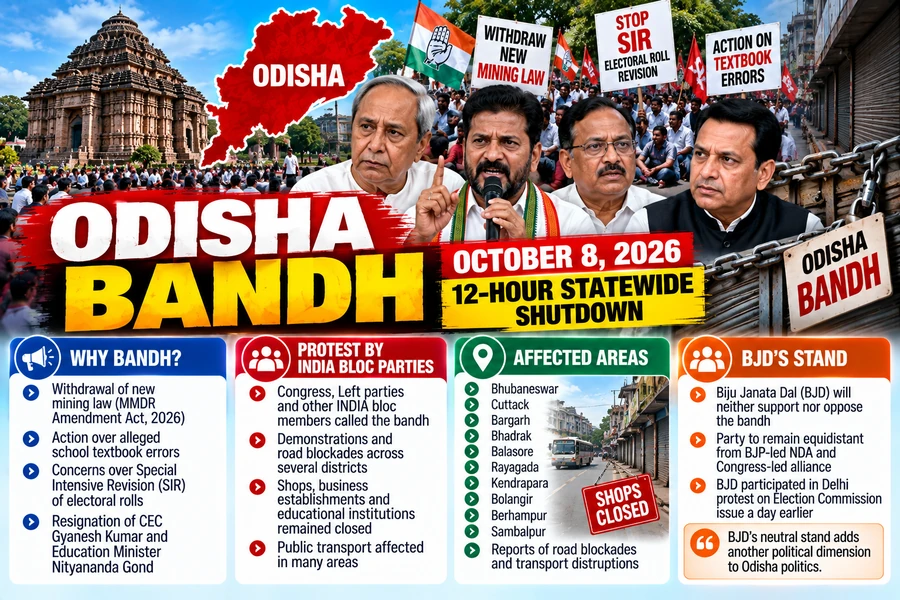
By Bhubaneswar, October 8, 2026: Political activity intensified across Odisha on Thursday as INDIA bloc parties observed a 12-hour statewide bandh, raising several demands including withdrawal of the new mining law, action over alleged errors in school textbooks and concerns related to the Special Intensive Revision (SIR) of electoral rolls. The bandh affected normal life in several parts of the state, with demonstrations, road blockades and disruptions to public transport reported from multiple districts.
Why Is Odisha Observing a Bandh?
The bandh has been called by several opposition parties in Odisha. Their demands include the withdrawal of the Mines and Minerals Development and Regulation (MMDR) Amendment Act, 2026, which has become a major political issue.
The protesting parties are also demanding action over alleged errors in school textbooks and raising concerns about the Special Intensive Revision of electoral rolls.
Another demand involves the resignation of Chief Election Commissioner Gyanesh Kumar and Odisha School and Mass Education Minister Nityananda Gond. These demands are part of the opposition parties’ broader political campaign.
Normal Life Affected Across Several Districts
The bandh affected normal activities in multiple parts of Odisha.
According to PTI reports, demonstrations and road blockades were reported in areas including Bhubaneswar, Cuttack, Bargarh, Bhadrak, Balasore, Rayagada, Kendrapara, Bolangir, Berhampur and Sambalpur.
Shops, business establishments and several educational institutions remained closed in the morning. Public transport, including buses and autorickshaws, was also affected in several locations.
BJD Takes a Different Position
The Biju Janata Dal (BJD) has taken a separate position on the bandh.
The Naveen Patnaik-led party announced on October 7 that it would neither support nor oppose the bandh. BJD media coordinator Lenin Mohanty said the party intended to remain equidistant from both the BJP-led NDA and the Congress-led opposition alliance.
The decision has become another point of political discussion in Odisha because BJD leaders had participated in an opposition protest in New Delhi a day earlier that called for the resignation of Chief Election Commissioner Gyanesh Kumar.
What Is the MMDR Amendment Issue?
The MMDR Amendment Act has become an important point of disagreement between the Odisha opposition parties and the central government.
The parties participating in the bandh are demanding withdrawal of the new legislation, arguing that changes to the mining framework could affect Odisha’s interests.
The mining sector is particularly significant for Odisha because the state has substantial mineral resources and a large mining-related economy.
The political debate therefore involves questions about mining regulation, state interests and the distribution of benefits from mineral resources.
SIR Electoral Roll Issue
The Special Intensive Revision of electoral rolls is another major issue behind the protest.
Opposition parties have raised concerns about the electoral-roll revision process and have demanded greater clarity regarding the exercise.
The same issue has also become part of the wider political confrontation between opposition parties and the Election Commission at the national level.
BJD’s Position Adds Another Political Dimension
The BJD’s decision to remain outside the bandh has added another dimension to Odisha politics.
While the party participated in an opposition demonstration in Delhi over the Election Commission issue, it has specifically chosen not to take a position for or against the Odisha bandh.
This position reflects the party’s stated approach of maintaining distance from both the BJP-led NDA and the Congress-led opposition alliance.
Political Debate Over Education Issues
The bandh also includes a demand for action over alleged errors in school textbooks.
The issue has brought Odisha’s education administration into the political discussion, with opposition parties demanding accountability from the state government.
The Odisha School and Mass Education Minister Nityanand Gond has consequently become one of the political figures mentioned in the opposition’s demands.
What Happened on the Ground?
Reports from several districts indicated road blockades and demonstrations during the bandh.
Protesters gathered at major junctions and some national highways, while vehicles including buses, trucks, taxis and autorickshaws were stopped at various locations.
The level of disruption differed between districts, with some areas reporting significant impact on transportation and commercial activity.
What Happens Next in Odisha Politics?
The immediate focus will be on how the Odisha government responds to the opposition’s demands and whether the issues raised during the bandh lead to further political discussions.
The MMDR Amendment Act, electoral-roll revision and education-related concerns are likely to remain subjects of political debate.
The BJD’s decision to maintain distance from the bandh could also remain an important part of the political conversation as the state’s parties position themselves on these issues.
Conclusion
Odisha witnessed significant political activity on October 8, 2026, as INDIA bloc parties observed a statewide bandh over the new mining law, electoral-roll revision concerns, textbook-related issues and demands for resignations. The BJD has maintained a separate position by choosing neither to support nor oppose the bandh, adding another layer to the state’s ongoing political debate.
This article is based on reports published on October 8, 2026. Political developments and the response to the bandh may continue to change.
Follow Us On Instagram