

 By
Introduction
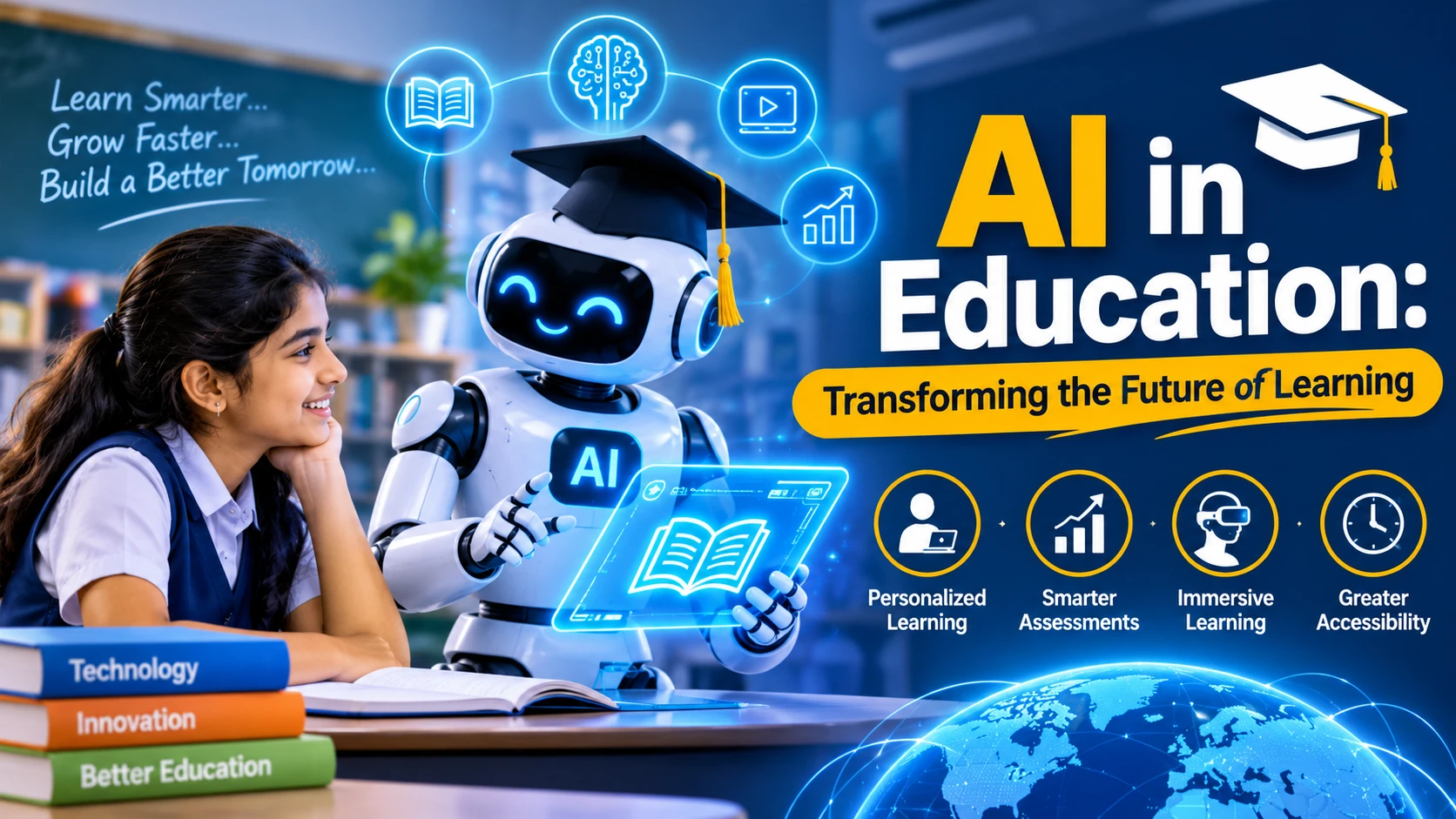
Artificial Intelligence (AI) is one of the most important technological developments in the modern world. It is transforming almost every sector, including healthcare, business, banking, transportation and education. AI in education refers to the use of intelligent technologies, computer systems and digital tools to improve teaching, learning and educational management. It helps students understand difficult subjects, supports teachers in their work and makes education more accessible and effective.
In today’s digital world, traditional teaching methods are gradually being supported by modern technologies. AI-powered applications, virtual tutors, smart classrooms and personalised learning platforms are changing the way students learn. Artificial Intelligence is not just a technological advancement; it is becoming an important part of the future education system.
1. Personalised Learning for Students
One of the biggest advantages of AI in education is personalised learning. Every student has different learning abilities, interests and levels of understanding. In traditional classrooms, teachers may find it difficult to give individual attention to every student.
AI-powered learning platforms can analyse students’ performance, identify their strengths and weaknesses, and recommend suitable learning materials. For example, if a student struggles with mathematics, an AI-based application can provide additional exercises, explanations and practice tests. Similarly, students who learn quickly can receive advanced learning materials.
This approach allows students to learn at their own speed and improves their confidence and academic performance.
2. AI as a Virtual Teacher
AI is becoming a helpful virtual teacher for students. AI-powered chatbots and educational assistants can answer questions, explain difficult concepts, solve mathematical problems and provide learning guidance.
Students can use AI tools to understand topics that they find difficult in textbooks. They can ask questions at any time without waiting for classroom hours. AI can also provide examples, summaries and practice questions to improve understanding.
However, AI should support human teachers rather than completely replace them. Teachers provide emotional support, motivation, discipline and personal guidance that technology cannot fully reproduce.
3. Benefits of AI for Teachers
Artificial Intelligence is not only beneficial for students but also for teachers. Teachers spend considerable time preparing lesson plans, checking assignments, evaluating tests and maintaining student records.
AI tools can help automate many routine activities, such as:
- Preparing quizzes and question papers.
- Checking objective-type answers.
- Creating lesson plans and presentations.
- Tracking student performance.
- Identifying students who need additional support.
By reducing administrative work, AI allows teachers to spend more time interacting with students, developing creative teaching methods and improving classroom experiences.
4. Smart Classrooms and Digital Education
AI is helping schools and colleges develop smart classrooms. Digital boards, interactive learning applications, virtual laboratories and AI-powered educational software make lessons more interesting and understandable.
For example, science students can perform virtual experiments, while geography students can explore maps and geographical locations using digital tools. Students can also watch educational videos and participate in interactive activities.
These technologies make learning more practical, enjoyable and student-centred. They also help educational institutions provide modern learning experiences.
5. AI in the Indian Education System
India is taking important steps towards integrating Artificial Intelligence into education. The National Education Policy (NEP) 2020 recognises the importance of emerging technologies and encourages the development of computational thinking, coding and AI-related skills.
In 2026, CBSE introduced a Computational Thinking and Artificial Intelligence curriculum for Classes III to VIII for the 2026–27 academic year. The curriculum focuses on logical thinking, problem-solving, creativity and responsible technology use.
The government is also promoting AI-related learning through digital education platforms, teacher training programmes and skill-development initiatives. These efforts aim to prepare Indian students for future technological developments.
6. Advantages of AI in Education
AI offers several important advantages to the education sector.
- 24/7 Learning: Students can access educational support at any time.
- Better Understanding: Complex subjects can be explained through simple examples and interactive methods.
- Time Saving: Teachers can automate repetitive administrative tasks.
- Improved Accessibility: AI tools can support students with disabilities through speech recognition, text-to-speech and translation.
- Instant Feedback: Students can identify mistakes and improve their performance quickly.
- Language Support: AI translation tools help students learn in different languages.
- Career Development: AI helps students develop digital skills required for future employment.
Therefore, AI can make education more flexible, inclusive and effective.
7. Challenges of AI in Education
Although AI provides many benefits, it also creates certain challenges.
Overdependence on Technology: Students may become dependent on AI for completing homework and assignments instead of developing their own thinking abilities.
Lack of Accuracy: AI tools sometimes provide incorrect or misleading information. Students must verify information using reliable sources.
Privacy and Data Security: Educational applications may collect personal information about students. Protecting this data is essential.
Digital Divide: Not all students have access to computers, smartphones and high-speed internet. This may increase educational inequality between urban and rural areas.
Reduced Human Interaction: Excessive use of technology may reduce communication between students and teachers.
Academic Dishonesty: Some students may use AI to generate assignments without understanding the subject.
According to UNESCO, responsible and inclusive AI integration requires attention to ethical practices, teacher capabilities and equal access to technology.
8. Responsible Use of AI in Education
To achieve the best results, AI must be used responsibly. Students should use AI as a learning assistant rather than a shortcut to success. Teachers should guide students on how to use AI tools for research, creativity and problem-solving.
Educational institutions should establish clear guidelines regarding AI-generated assignments, data protection and academic honesty. Teachers must also receive proper training to understand AI technologies and use them effectively.
Most importantly, students should develop critical thinking, creativity, communication and decision-making skills alongside technological knowledge.
9. Future of AI in Education
The future of education will involve greater collaboration between human teachers and Artificial Intelligence. AI may help develop personalised digital classrooms, intelligent tutoring systems, advanced virtual laboratories and interactive learning environments.
Students may have access to individual AI learning assistants that understand their educational needs and provide customised learning experiences.
AI-related skills will also become increasingly important in careers such as engineering, medicine, business, agriculture, science and information technology. Educational institutions must prepare students to work with these technologies.
However, the human values of education, including kindness, discipline, creativity, teamwork and social responsibility, will remain essential.
Conclusion
Artificial Intelligence is transforming the education system by making learning smarter, faster, more personalised and accessible. It provides valuable opportunities for students, teachers and educational institutions. From virtual teaching assistants to smart classrooms, AI is changing traditional educational practices and creating new possibilities for the future.
However, technology alone cannot provide quality education. Human teachers, ethical values, creativity and personal interaction remain important parts of the learning process.
Therefore, the best approach is to combine the intelligence of technology with the wisdom of human teachers. If AI is used responsibly and effectively, it can create a more innovative, inclusive and powerful education system and help build a better future for the next generation.
Follow Us On Instagram.