

 By
By Physical Security in 2026: Protecting People, Property, and Critical Assets
In an increasingly digital world, cybersecurity often gets the most attention. However, physical security remains just as important because it protects the real-world environments where people, systems, and critical infrastructure operate. Offices, data centers, hospitals, factories, and residential buildings all rely on physical security to prevent unauthorized access, theft, vandalism, and safety hazards.
In 2026, physical security has evolved beyond traditional locks and guards. Modern systems now integrate smart technologies, AI-powered surveillance, and biometric authentication to create stronger, more responsive protection systems.
Physical security focuses on safeguarding people, property, and physical assets through preventive and responsive security measures.
What is Physical Security?
Physical security refers to the protection of buildings, assets, and individuals from physical threats such as intrusion, theft, damage, fire, and sabotage. It combines human presence, mechanical tools, and electronic systems to create multiple layers of protection.
Key components of physical security include:
- Security guards and personnel
- Locks and barriers
- CCTV surveillance systems
- Fire detection and alarm systems
- Access control systems
- Biometric authentication
- Intrusion detection systems
These elements work together to prevent unauthorized entry and ensure a safe environment for operations.
Why Physical Security Matters
Even with advanced cybersecurity systems, physical access to facilities can lead to serious risks. If an attacker gains physical access to servers, offices, or infrastructure systems, they can bypass digital protections entirely.
Poor physical security can result in:
- Theft of equipment or sensitive documents
- Unauthorized access to IT systems
- Workplace safety incidents
- Vandalism or sabotage
- Fire-related damage
- Business downtime
For organizations handling sensitive data or critical infrastructure, physical security is essential for maintaining both safety and operational continuity.
Locks and Barriers: First Line of Defense
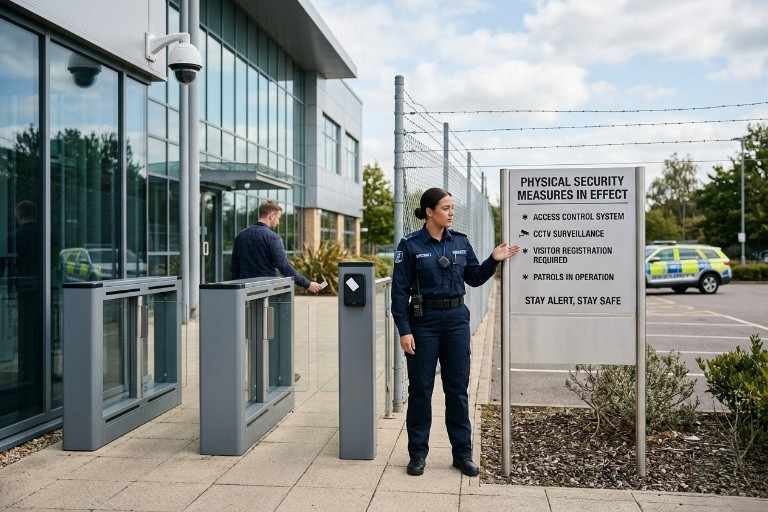
Traditional security methods like locks, gates, and barriers remain a fundamental part of physical security. They provide the first layer of protection by restricting unauthorized entry.
Modern systems now include:
Electronic Smart Locks
These allow controlled access using digital credentials instead of physical keys.
Reinforced Barriers
Used in high-security zones such as data centers, military sites, and industrial facilities.
Turnstiles and Access Gates
These systems regulate entry and exit in commercial buildings and secure facilities.
While simple, these mechanisms are highly effective when combined with other security systems.
Security Guards and Human Surveillance
Despite advances in technology, human security personnel remain a critical part of physical security. Security guards provide real-time monitoring, immediate response to incidents, and human judgment in unexpected situations.
Their responsibilities include:
- Monitoring entry and exit points
- Verifying identification
- Responding to emergencies
- Patrolling facilities
- Coordinating with law enforcement
Security personnel act as both deterrence and response units, making them essential for high-risk environments.
CCTV Cameras and Smart Surveillance
CCTV systems are one of the most widely used physical security technologies. They provide continuous monitoring and recording of activities within and around a facility.
In 2026, CCTV systems are more advanced than ever, featuring:
Night vision and thermal imaging
AI-based motion detection
Facial recognition
Real-time alerts
Cloud-based video storage
These smart surveillance systems help detect suspicious activity early and support investigations after incidents occur.
Modern AI-enabled CCTV can also distinguish between normal and abnormal behavior, reducing false alarms and improving response efficiency.
Fire Alarms and Emergency Systems
Fire safety is a critical aspect of physical security. Fire alarms, smoke detectors, and sprinkler systems help protect lives and property by detecting and responding to fire hazards quickly.
Key fire safety systems include:
Smoke Detectors
Identify smoke particles early to trigger alarms.
Fire Alarm Systems
Alert occupants and security teams during emergencies.
Sprinkler Systems
Automatically suppress fires to minimize damage.
Emergency Exit Systems
Ensure safe evacuation routes during emergencies.
Regular maintenance and testing of fire safety systems are essential to ensure they function properly when needed.
Biometrics and Advanced Access Control
Biometric security systems are becoming increasingly common in modern buildings and secure facilities. These systems use unique human characteristics for identity verification.
Common biometric methods include:
Voice recognition
Fingerprint scanning
Facial recognition
Iris scanning
Biometrics provide a higher level of security compared to traditional passwords or ID cards because they are difficult to duplicate or steal.
In 2026, many organizations are combining biometrics with multi-factor authentication for even stronger access control.
Emerging Trends in Physical Security
Physical security is rapidly evolving with the integration of digital technologies.
Key trends include:
AI-Powered Surveillance
Systems that automatically detect suspicious behavior and alert security teams.
Integrated Security Systems
Combining CCTV, access control, alarms, and cybersecurity into unified platforms.
Smart Building Security
IoT-enabled buildings that automate security responses.
Cloud-Based Monitoring
Remote access to security systems from anywhere in the world.
Zero Trust Physical Access Models
Continuous verification of identity before granting access to secure zones.
These innovations are making physical security more proactive, intelligent, and efficient.