 By
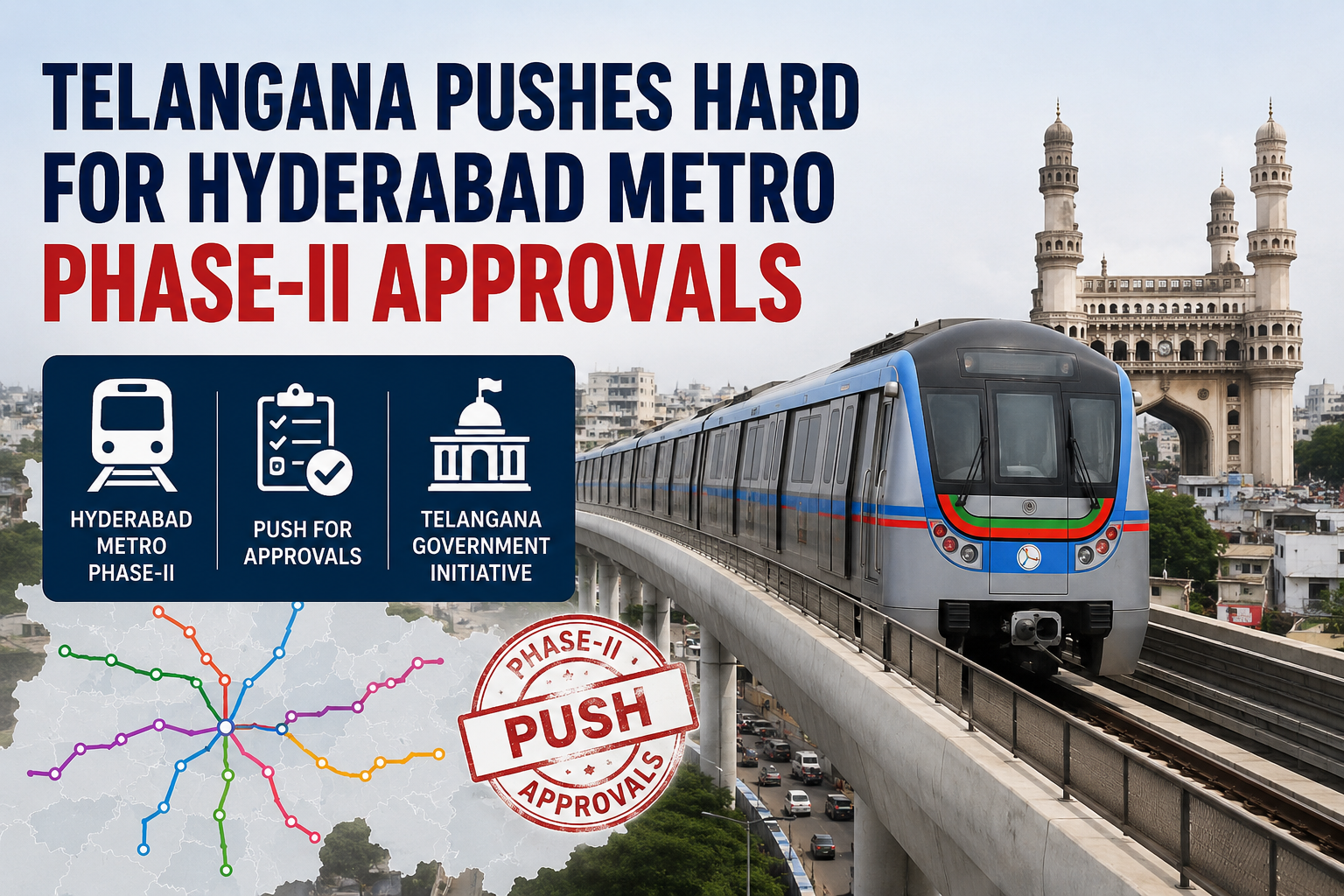
By The government of Telangana has intensified its efforts to secure faster approvals and financial support from the Central government for the Phase-II expansion of the Hyderabad Metro Rail project. With rapid urban growth and increasing traffic congestion in Hyderabad, the state government considers metro expansion one of its most important infrastructure priorities.
Chief Minister A. Revanth Reddy has been actively engaging with Union ministers and Prime Minister Narendra Modi to seek speedy clearances for the proposed metro corridors. The Telangana government argues that expanding the metro network is essential for improving urban mobility, reducing road congestion, and supporting Hyderabad’s growing population and economy.
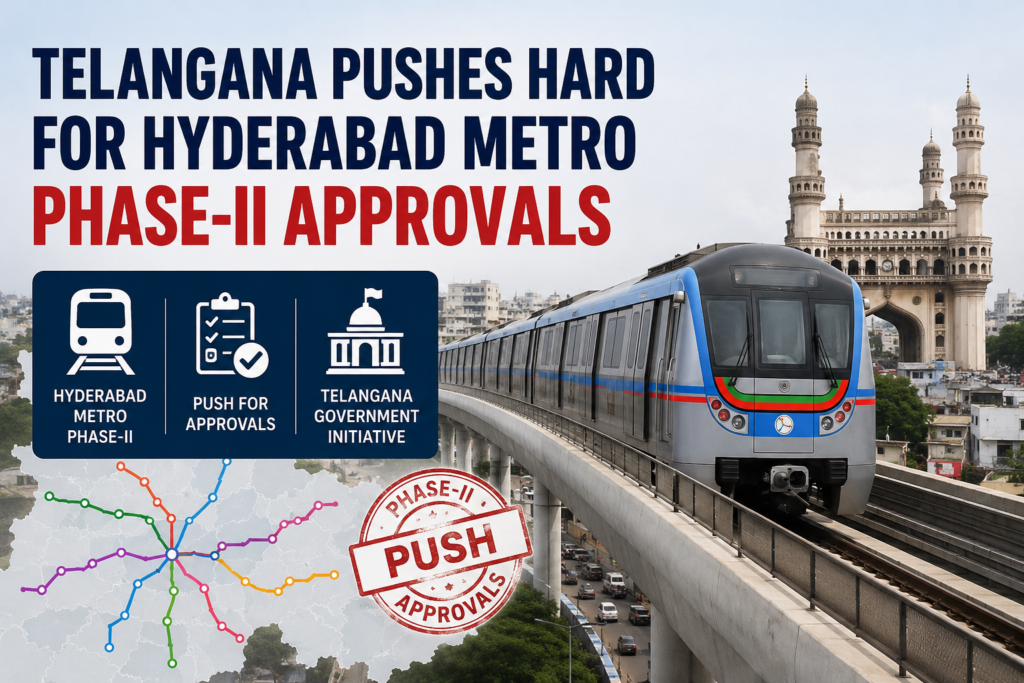
The proposed Phase-II expansion includes plans to extend metro connectivity to rapidly developing residential zones, IT corridors, business districts, and suburban areas. Officials believe these new routes will help improve daily commuting for lakhs of residents while also strengthening integration between different parts of the city. Better public transport infrastructure is also expected to support economic activity, reduce travel time, and improve overall urban planning.
The Hyderabad Metro has already emerged as one of India’s major urban transit systems, carrying large numbers of passengers daily. However, with Hyderabad continuing to expand as a technology, business, and investment hub, transportation demands have increased significantly. The state government sees metro expansion as a long-term solution for managing future urban growth sustainably.
The Telangana government has also highlighted the economic importance of the project. Large infrastructure investments such as metro expansion can generate employment opportunities, attract investment, and stimulate growth in sectors such as real estate, retail, and construction. Improved connectivity is expected to strengthen Hyderabad’s position as a leading destination for technology companies and global investors.
At the political level, the metro expansion project has become part of the broader governance narrative of the ruling Indian National Congress government. Congress leaders have been promoting infrastructure development as evidence of proactive governance and modernization efforts. By focusing on urban mobility and public transportation, the government aims to project itself as development-oriented and future-focused.
At the same time, the issue has also become politically sensitive because of the growing rivalry between Congress and the Bharatiya Janata Party (BJP). Congress leaders have accused the Centre of delaying approvals for Telangana projects, while BJP leaders insist that the Central government has consistently supported development initiatives in the state. This political exchange has added further attention to the metro expansion discussions.
Meanwhile, the Bharat Rashtra Samithi (BRS) has also remained active in the debate, highlighting the previous government’s role in launching and expanding the metro system during its tenure. BRS leaders continue criticizing both Congress and BJP while defending their own infrastructure development record.
Experts note that implementing metro expansion projects involves several challenges, including land acquisition, financing, environmental clearances, and coordination between multiple government agencies. Delays in approvals or funding could impact timelines and increase project costs. Therefore, strong cooperation between the state and Central governments will be essential for ensuring smooth execution.
Urban planners believe that successful expansion of the metro network could significantly improve Hyderabad’s future transportation system. Integrated mobility solutions connecting metro rail with buses, roads, and suburban transport systems could reduce traffic congestion and improve commuter convenience. Such developments are also considered important for improving environmental sustainability and reducing pollution levels.
In conclusion, Telangana’s push for Hyderabad Metro Phase-II approvals reflects the state government’s strong focus on infrastructure-led urban development. The project carries major economic, governance, and political significance, making it one of the most closely watched development initiatives in Telangana. As discussions with the Centre continue, metro expansion is expected to remain a central theme in both governance planning and political discourse across the state.