

 By
By The Rise of AI PCs: How Computers Are Becoming Smarter in 2026
Computers are entering a new phase in 2026. For decades, improvements in PCs were mainly about faster processors, better graphics, larger storage, and improved displays. Today, artificial intelligence is becoming one of the biggest forces shaping the next generation of computers.
The latest trend is the rise of AI PCs—computers designed with dedicated hardware and software for running artificial intelligence tasks. Instead of sending every AI request to the cloud, modern computers can increasingly process AI workloads directly on the device. This can improve responsiveness, privacy, and efficiency.
What Is an AI PC?
An AI PC is a computer equipped with hardware specifically designed to accelerate artificial intelligence workloads. Alongside the traditional CPU and GPU, many new systems include an NPU (Neural Processing Unit).
The NPU is designed to handle AI-related tasks efficiently while using less power than relying entirely on the CPU or GPU. This makes it useful for features such as real-time translation, image processing, voice recognition, background effects during video calls, document assistance, and other AI applications.
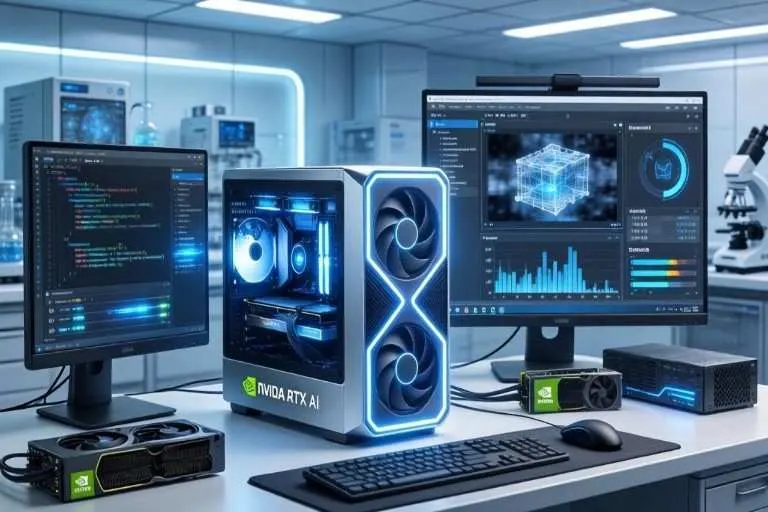
The September 2026 computer market is increasingly focused on AI-ready laptops, desktops, developer PCs, compact AI workstations, and AI-focused business systems.
Local AI Is Becoming More Important
One of the most interesting developments is the shift toward on-device AI. Instead of constantly depending on a remote data center, some AI functions can run directly on a laptop or desktop.
This approach can offer several advantages. Local processing can reduce the time required to send information to a server and receive a response. It can also be valuable for privacy-sensitive tasks because certain information can remain on the user’s computer.
Another important development is the improvement of smaller AI models. Recent technology trends show that increasingly capable models can run on laptops or individual accelerators rather than requiring enormous data-center infrastructure.
More Powerful Hardware for AI Workloads
AI is also changing what people expect from computer hardware. Modern systems increasingly combine CPUs, GPUs, and NPUs to handle different types of workloads.
High-performance AI computers require substantial memory bandwidth and processing capacity. This is also affecting the wider semiconductor industry. Recent reports show that demand for AI computing is contributing to shortages and higher prices for high-bandwidth memory used in AI processors.
For consumers, this could eventually influence the price and availability of laptops, desktops, graphics cards, and other computer components.
AI PCs Are Reaching More Users
AI computers are no longer limited to research laboratories or high-end workstations. Manufacturers are introducing AI-enabled laptops across different price categories.
In India, for example, recent PC launches have included business laptops and workstations equipped with processors such as Intel Core Ultra and AMD Ryzen AI.
This means students, office workers, developers, content creators, and everyday users are increasingly likely to encounter AI features when purchasing their next computer.
What Does This Mean for Consumers?
The biggest change is that computers are becoming more than tools for running applications. They are increasingly becoming intelligent assistants capable of understanding voice, text, images, and context.
For students, AI PCs can assist with research, writing, summarization, and learning. Professionals can use AI for productivity and communication. Developers can run coding assistants and smaller AI models locally. Creators can benefit from AI-powered image, audio, and video tools.
However, buyers should not purchase a computer simply because it carries an “AI PC” label. Processor performance, RAM, storage, battery life, graphics capability, display quality, software compatibility, and upgradeability still matter.
The Future of Computers
The AI PC trend is only beginning. Future computers are likely to become increasingly capable of running AI locally, with CPUs, GPUs, and NPUs working together.
The direction is clear: computers are evolving from machines that simply execute instructions into systems that can understand, predict, assist, and create. As AI hardware becomes more affordable and software becomes more capable, these features are likely to become a standard part of everyday computing.
For anyone planning to buy a new laptop or desktop in 2026, AI capabilities are now worth considering alongside traditional specifications. The next generation of computing is not just about making computers faster—it is about making them smarter.
Sources: Current 2026 industry trends indicate growing interest in AI-ready business desktops, AI developer PCs, compact AI workstations, and entry-level AI laptops.