

 By
By AI PCs in 2026: How Artificial Intelligence Is Changing the Future of Computers
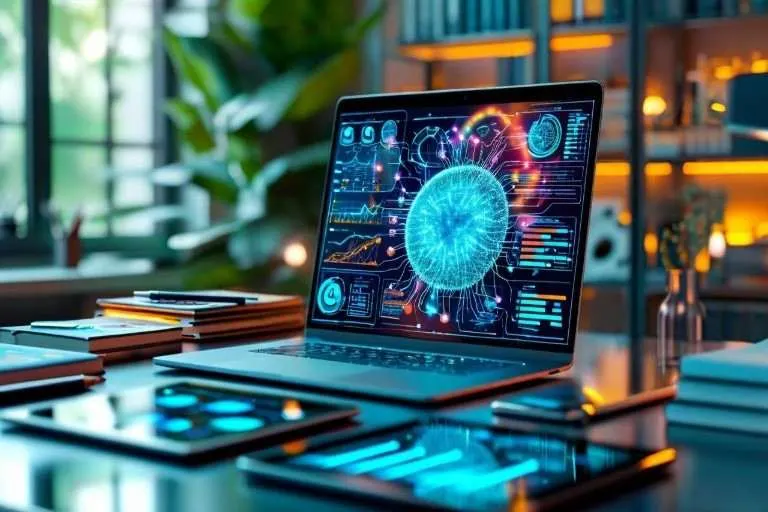
The computer industry is entering a new phase in 2026 as artificial intelligence becomes one of the most important features in modern PCs and laptops. Instead of depending entirely on cloud servers, newer computers are increasingly designed to process AI workloads directly on the device. This shift is changing how people work, create content, play games and interact with their computers.
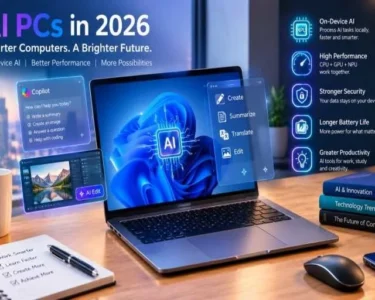
AI laptops are no longer simply a futuristic concept. Current models from major manufacturers are integrating dedicated Neural Processing Units (NPUs) alongside traditional CPUs and GPUs. These specialized processors can handle certain AI tasks more efficiently, helping computers perform functions such as transcription, background removal, image processing and intelligent assistants without sending every task to the cloud.
What Makes an AI PC Different?
Traditional computers primarily rely on the CPU and GPU for processing. AI PCs add another important component: the NPU.
An NPU is designed specifically for artificial-intelligence workloads. Instead of using the CPU for every AI operation, compatible applications can use the NPU to perform certain tasks more efficiently. This can potentially reduce power consumption while allowing AI features to operate continuously in the background.
For laptop users, this is particularly important because battery life remains one of the biggest concerns with portable computers. Efficient on-device processing could allow users to access more AI features without constantly connecting to a charger or cloud service.
On-Device AI Is Becoming More Important
One of the biggest trends in 2026 is the move toward local AI processing. Modern laptop-sized AI models are becoming increasingly capable, and some can run directly on consumer hardware rather than requiring a large data-center connection.
This can provide several advantages. Local processing can reduce latency because information does not always need to travel to a remote server. It can also improve privacy because some tasks can remain on the user’s computer.
For professionals, this could be particularly useful when working with confidential documents, business information or creative projects.
AI Is Changing Everyday Computer Tasks
AI PCs are also changing what users expect from their computers.
Imagine opening a laptop and asking it to summarize a long document, organize files, generate an image, remove unwanted objects from a photograph or transcribe a meeting. These capabilities are increasingly becoming part of the PC experience rather than separate online services.
For students, AI-enabled computers can assist with research and productivity. For office workers, they can help with meetings, documents and communication. Creators can benefit from AI-powered video, audio and image tools, while developers can use local AI assistants for coding and troubleshooting.
Performance Is Not the Only Competition
The competition between computer manufacturers is no longer simply about processor speed.
In 2026, manufacturers are competing across AI performance, battery life, thermal efficiency, graphics performance, displays and portability. Industry trends also include compact AI workstations, repairable laptops and specialized hardware designed for localized AI processing.
At the same time, the cost of computer hardware is becoming an important issue. A global memory shortage linked to strong AI infrastructure demand is putting pressure on PC makers and component prices. Recent reports indicate that manufacturers are selling fewer PCs at higher prices, particularly in premium AI-focused categories.
What Does This Mean for Buyers?
For consumers planning to purchase a new laptop or desktop in 2026, the processor name alone should not be the only consideration.
Buyers should look at NPU capability, RAM, storage, GPU performance, battery life, display quality and software compatibility. Someone who mainly browses the web and uses office applications may not need a high-end AI workstation, while creators, developers and professionals working with AI applications may benefit significantly from more powerful hardware.
The good news is that AI technology is gradually reaching different price segments, giving consumers more choices.
The Future of Computers
The future computer is likely to be more intelligent, personalized and capable of understanding what users need. Instead of simply responding to commands, AI-powered PCs could increasingly anticipate tasks, organize information and assist users throughout the day.
The biggest change may be that AI will become a normal part of the computer rather than a separate application.
As processors, NPUs and AI software continue to improve, 2026 could become an important turning point for personal computing. The PC is no longer just a machine for running applications—it is evolving into an intelligent assistant capable of helping users work faster and more efficiently.
In short, AI PCs are not just another computer trend. They represent the next major evolution of personal computing.