

 By
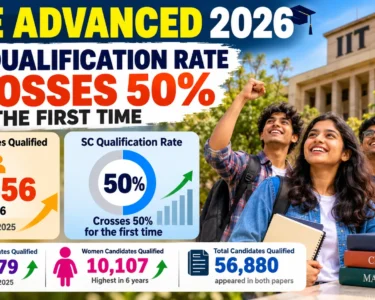
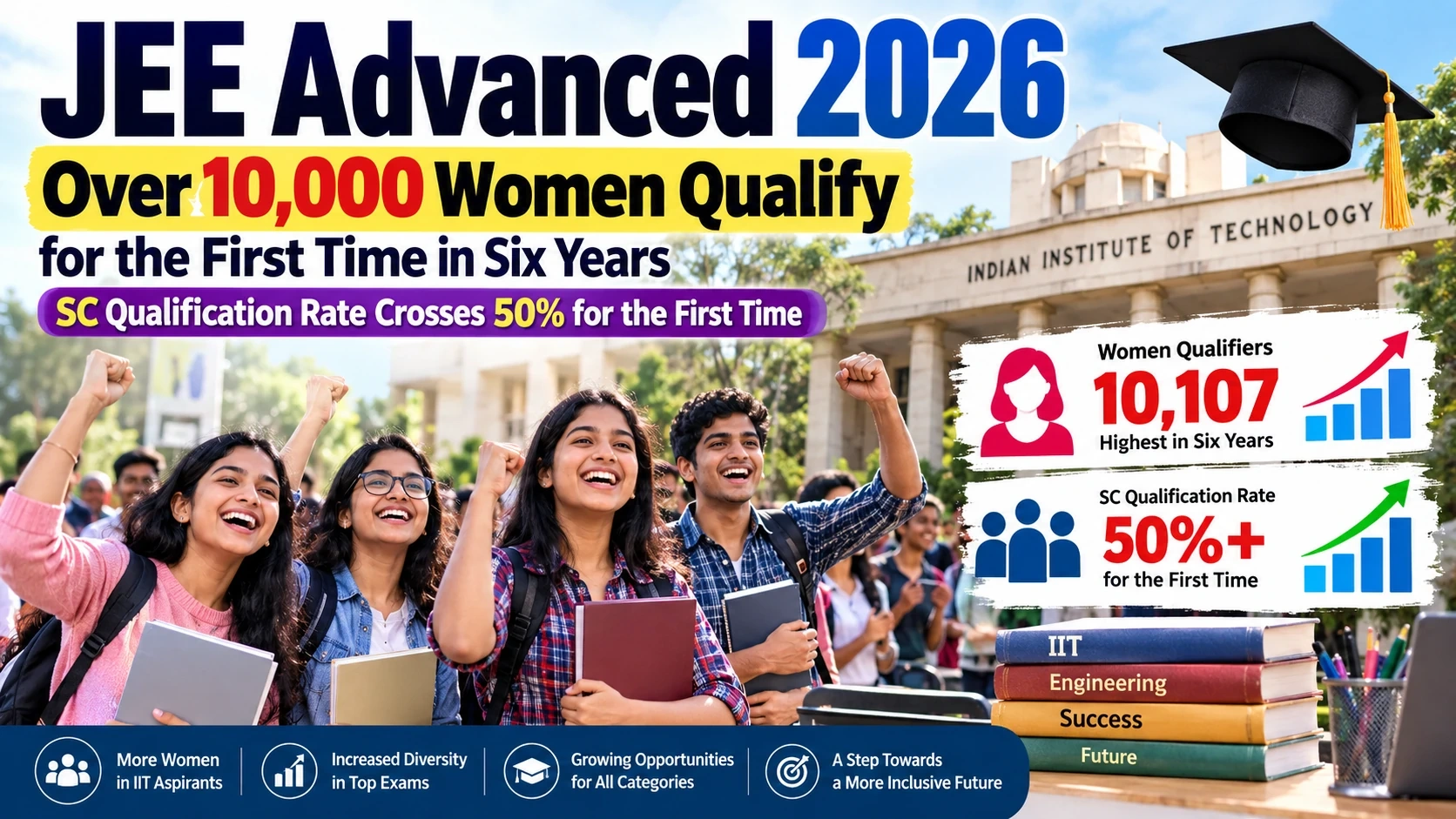
By New Delhi: JEE Advanced 2026 has brought significant changes to the profile of students qualifying for one of India’s most competitive engineering entrance examinations. According to the Joint Implementation Committee report prepared by IIT Roorkee, 10,107 female candidates qualified for JEE Advanced 2026, making it the first time in six years that the number of women qualifiers has crossed the 10,000 mark. At the same time, the qualification rate among Scheduled Caste (SC) candidates crossed 50% for the first time, highlighting a major shift in representation among successful candidates. JEE Advanced
JEE Advanced is the gateway to undergraduate programmes at the Indian Institutes of Technology (IITs) and is considered one of the toughest engineering entrance examinations in the country. The 2026 examination was conducted on May 17 in two papers. A total of 1,87,389 candidates registered, while 1,79,694 candidates appeared in both papers. Out of them, 56,880 candidates qualified for the examination. JEE Advanced
Women Qualifiers Cross 10,000
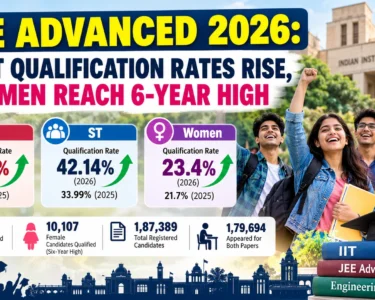
One of the biggest highlights of JEE Advanced 2026 is the increase in the number of successful women candidates. A total of 43,112 female candidates registered for the examination, and 40,562 appeared in both papers. Among them, 10,107 candidates qualified.
The qualification rate among registered female candidates increased from 21.7% in 2025 to 23.4% in 2026. When calculated among women who appeared in both papers, the success rate was even higher at around 24.9%. The Indian Express
This is an important development because engineering and technology education in India has historically seen lower female participation compared with male students. The latest numbers indicate that more women are not only appearing for highly competitive engineering examinations but are also successfully clearing them.
The achievement of female candidates was further highlighted by the performance of Arohi Deshpande, who emerged as the top-ranked female candidate. She secured All India Rank 77, scoring 280 out of 360 marks. Her subject-wise scores included 101 in Mathematics, 86 in Physics and 93 in Chemistry. JEE Advanced
SC Qualification Rate Crosses 50%
Another major development in the JEE Advanced 2026 report is the performance of SC candidates.
For the first time, the qualification rate among SC candidates crossed the 50% mark, reaching approximately 50.2% when calculated using the registered-candidate base, according to the Joint Implementation Committee report. The number of SC qualifiers also increased significantly compared with the previous year. The Indian Express
In 2026, 15,856 SC candidates qualified, compared with around 12,500 in the previous year. The number of ST qualifiers also increased substantially, reaching 6,379 candidates, compared with about 5,000 in the previous year. The Indian Express
The improvement among SC and ST candidates is being viewed as an important development for diversity in India’s premier technical institutions. It indicates that students from historically underrepresented communities are increasingly entering the highly competitive IIT admission pipeline.
Overall Qualification Numbers
The total number of successful candidates also increased in 2026. Of the 1,79,694 candidates who appeared in both papers, 56,880 qualified.
The official JEE Advanced results show that the Common Rank List (CRL) was topped by Shubham Kumar from the IIT Delhi zone, who scored an impressive 330 out of 360 marks. The second and third positions were secured by Kaber Chhillar and Jatin Chahar respectively. JEE Advanced
The qualifying marks varied across categories. Candidates in the Common Rank List needed a minimum of 8 marks in each subject and 92 marks overall. For OBC-NCL and GEN-EWS candidates, the minimum aggregate requirement was 82 marks, while SC and ST candidates had a minimum aggregate requirement of 46 marks under the respective rank lists. The Indian Express
IIT Admissions and Women’s Representation
The increase in the number of women qualifying is significant, but qualification is only the first stage. The next important question is how many women eventually secure seats in IITs.
According to the 2026 report, 3,814 female candidates received IIT seat allotments, including candidates who obtained seats through the gender-neutral pool. The figure represents an increase from the previous year. The Indian Express
Women accounted for approximately 20.22% of IIT seat allotments, a marginal increase from around 20.15% in the previous year. The numbers show progress, although the representation of women in IITs remains lower than their overall participation in several stages of the examination process. The Times of India
IITs have introduced additional women-only supernumerary seats over the years as part of efforts to improve female representation in undergraduate engineering programmes. These seats are intended to increase the proportion of women entering the IIT system without reducing the number of seats available through the regular gender-neutral pool.
What Does the 2026 Data Mean?
The JEE Advanced 2026 figures provide several important lessons for students, parents and policymakers.
First, the increase in female qualifiers shows that more women are competing successfully in India’s most demanding engineering entrance examination. The rise could encourage more school students to consider engineering, computer science, technology and research careers.
Second, the increase in SC and ST qualification rates highlights changes in the demographic composition of successful candidates. Better access to coaching, educational resources, scholarships and awareness about competitive examinations could contribute to improved participation.
However, qualification numbers alone do not tell the complete story. Students must still compete for limited seats across different IITs and programmes. The transition from qualifying JEE Advanced to obtaining a preferred branch at a preferred IIT remains highly competitive.
A Positive Signal for Indian Technical Education
JEE Advanced 2026 therefore represents more than just another set of examination results. The figures indicate gradual changes in who is succeeding in India’s elite engineering entrance system.
With 10,107 women qualifying, female participation has reached a six-year high. At the same time, the SC qualification rate crossing 50% marks another significant milestone. JEE Advanced
These developments could have a long-term impact on the diversity of India’s engineering and technology workforce. More women and students from underrepresented communities entering IITs can eventually translate into greater diversity in research, technology companies, startups, academia and other technical fields.
For students preparing for future JEE examinations, the 2026 results also reinforce an important message: consistent preparation, strong fundamentals and strategic practice remain essential. JEE Advanced continues to demand deep conceptual understanding rather than simple memorisation.
As India expands its focus on technology, artificial intelligence, semiconductor manufacturing, research and innovation, increasing participation from different sections of society will become increasingly important.
The JEE Advanced 2026 results therefore stand out as a significant moment for Indian education — combining record female qualification numbers, stronger representation of SC and ST candidates, and continued intense competition for admission to the country’s premier engineering institutions.
Follow Us On Instagram.